<?xml version="1.0" encoding="utf-8"?>

<feed xmlns="http://www.w3.org/2005/Atom">
<title>neuro</title>
<generator uri="http://tt-rss.org/">Tiny Tiny RSS/25.04-f097c5ed9 (Unsupported)</generator>
<updated>2014-06-15T16:01:45+00:00</updated>
<id>https://gate.ccdw.org/tt-rss/public.php?op=rss&amp;id=-1026&amp;key=bkrh3g537ea8c29f433</id>
<link href="https://gate.ccdw.org/tt-rss/public.php?op=rss&amp;id=-1026&amp;key=bkrh3g537ea8c29f433" rel="self"/>

<link href="https://gate.ccdw.org/tt-rss" rel="alternate"/>

<entry>
	<id>tag:gate.ccdw.org,2023-10-16:/2022582</id>
	<link href="http://arxiv.org/abs/2301.00759" rel="alternate" type="text/html"/>
	<title type="html">Neural criticality from effective latent variables. (arXiv:2301.00759v3 [q-bio.NC] UPDATED)</title>
	<summary type="html"><![CDATA[Observations of power laws in neural activity data have raised the intriguing
notion that brains may...]]></summary>
	<content type="html"><![CDATA[<p>Observations of power laws in neural activity data have raised the intriguing
notion that brains may operate in a critical state. One example of this
critical state is "avalanche criticality," which has been observed in various
systems, including cultured neurons, zebrafish, rodent cortex, and human EEG.
More recently, power laws were also observed in neural populations in the mouse
under an activity coarse-graining procedure, and they were explained as a
consequence of the neural activity being coupled to multiple latent dynamical
variables. An intriguing possibility is that avalanche criticality emerges due
to a similar mechanism. Here, we determine the conditions under which latent
dynamical variables give rise to avalanche criticality. We find that
populations coupled to multiple latent variables produce critical behavior
across a broader parameter range than those coupled to a single, quasi-static
latent variable, but in both cases, avalanche criticality is observed without
fine-tuning of model parameters. We identify two regimes of avalanches, both
critical but differing in the amount of information carried about the latent
variable. Our results suggest that avalanche criticality arises in neural
systems in which activity is effectively modeled as a population driven by a
few dynamical variables and these variables can be inferred from the population
activity.
</p>]]></content>
	<updated>2023-10-16T12:36:23+00:00</updated>
	<author><name>Mia C. Morrell, Ilya Nemenman, Audrey J. Sederberg</name></author>
	<source>
		<id>http://arxiv.org/</id>
		<link rel="self" href="http://arxiv.org/"/>
		<updated>2023-10-16T12:36:23+00:00</updated>
		<title>q-bio updates on arXiv.org</title></source>


</entry>

<entry>
	<id>tag:gate.ccdw.org,2023-08-21:/1986859</id>
	<link href="https://www.nature.com/articles/s41467-023-40651-w" rel="alternate" type="text/html"/>
	<title type="html">Sequence anticipation and spike-timing-dependent plasticity emerge from a predictive learning rule</title>
	<summary type="html"><![CDATA[]]></summary>
	<content type="html"><![CDATA[]]></content>
	<updated>2023-08-21T00:00:00+00:00</updated>
	<author><name>Matteo Saponati et al.</name></author>
	<source>
		<id>https://www.nature.com/subjects/computational-neuroscience.atom/</id>
		<link rel="self" href="https://www.nature.com/subjects/computational-neuroscience.atom/"/>
		<updated>2023-08-21T00:00:00+00:00</updated>
		<title>Computational neuroscience : nature.com subject feeds</title></source>


</entry>

<entry>
	<id>tag:gate.ccdw.org,2023-03-14:/1888936</id>
	<link href="https://neurosciencenews.com/math-models-brain-state-22789/" rel="alternate" type="text/html"/>
	<title type="html">Detecting Hidden Brain States With Mathematical Models</title>
	<summary type="html"><![CDATA[Using a mathematical model to study how the brain predicts information and learns, researchers disco...]]></summary>
	<content type="html"><![CDATA[<a href="https://neurosciencenews.com/math-models-brain-state-22789/" title="Detecting Hidden Brain States With Mathematical Models" rel="noopener noreferrer" target="_blank"><img src="https://neurosciencenews.com/files/2023/03/brain-state-math-model-neurosinces-1.jpg" alt="This shows a brain scan from the study" decoding="async" link_thumbnail="1" loading="lazy" srcset="https://neurosciencenews.com/files/2023/03/brain-state-math-model-neurosinces-1.jpg 770w,https://neurosciencenews.com/files/2023/03/brain-state-math-model-neurosinces-1-300x235.jpg 300w,https://neurosciencenews.com/files/2023/03/brain-state-math-model-neurosinces-1-293x229.jpg 293w" sizes="(max-width: 770px) 100vw, 770px" referrerpolicy="no-referrer"></a>Using a mathematical model to study how the brain predicts information and learns, researchers discovered signals for accuracy are found in the anterior insula and anxiety affects activity levels in this brain region.]]></content>
	<updated>2023-03-14T20:18:45+00:00</updated>
	<author><name>Neuroscience News</name></author>
	<source>
		<id>http://neurosciencenews.com</id>
		<link rel="self" href="http://neurosciencenews.com"/>
		<updated>2023-03-14T20:18:45+00:00</updated>
		<title>Neuroscience RSS Feeds - Neuroscience News Updates</title></source>

	<category term="anxiety"/>

	<category term="brain research"/>

	<category term="emotion"/>

	<category term="eth zurich"/>

	<category term="featured"/>

	<category term="homeostasis"/>

	<category term="mathematical modeling"/>

	<category term="mental health"/>

	<category term="neurobiology"/>

	<category term="neuroscience"/>

	<category term="psychology"/>


</entry>

<entry>
	<id>tag:gate.ccdw.org,2023-01-23:/1861222</id>
	<link href="https://neurosciencenews.com/spatial-temporal-memory-22328/" rel="alternate" type="text/html"/>
	<title type="html">Our Memory for Objects Might Be Better Than We Think</title>
	<summary type="html"><![CDATA[A test of temporal and spatial memory reveals people are better at remembering where and when people...]]></summary>
	<content type="html"><![CDATA[<a href="https://neurosciencenews.com/spatial-temporal-memory-22328/" title="Our Memory for Objects Might Be Better Than We Think" rel="noopener noreferrer" target="_blank"><img src="https://neurosciencenews.com/files/2023/01/object-memory-neurosicence--770x770.jpg" alt="This shows a grid with random objects in the squares" decoding="async" link_thumbnail="1" srcset="https://neurosciencenews.com/files/2023/01/object-memory-neurosicence--770x770.jpg 770w,https://neurosciencenews.com/files/2023/01/object-memory-neurosicence--100x100.jpg 100w,https://neurosciencenews.com/files/2023/01/object-memory-neurosicence--293x293.jpg 293w,https://neurosciencenews.com/files/2023/01/object-memory-neurosicence--390x390.jpg 390w,https://neurosciencenews.com/files/2023/01/object-memory-neurosicence--585x585.jpg 585w,https://neurosciencenews.com/files/2023/01/object-memory-neurosicence--96x96.jpg 96w" sizes="(max-width: 770px) 100vw, 770px" referrerpolicy="no-referrer" loading="lazy"></a>A test of temporal and spatial memory reveals people are better at remembering where and when people saw objects than previously thought.]]></content>
	<updated>2023-01-23T18:58:59+00:00</updated>
	<author><name>Neuroscience News</name></author>
	<source>
		<id>http://neurosciencenews.com</id>
		<link rel="self" href="http://neurosciencenews.com"/>
		<updated>2023-01-23T18:58:59+00:00</updated>
		<title>Neuroscience RSS Feeds - Neuroscience News Updates</title></source>

	<category term="brain research"/>

	<category term="brigham and womens hospital"/>

	<category term="featured"/>

	<category term="memory"/>

	<category term="neurobiology"/>

	<category term="neuroscience"/>

	<category term="object categories"/>

	<category term="open access"/>

	<category term="open neuroscience articles"/>

	<category term="open science"/>

	<category term="spatial memory"/>

	<category term="temporal memory"/>


</entry>

<entry>
	<id>tag:gate.ccdw.org,2022-12-23:/1846850</id>
	<link href="https://neurosciencenews.com/fear-memory-22134/" rel="alternate" type="text/html"/>
	<title type="html">How the Brain Stores Remote Fear Memory</title>
	<summary type="html"><![CDATA[Remote fear memories, or memories of trauma formed in the distant past, are stored in the connection...]]></summary>
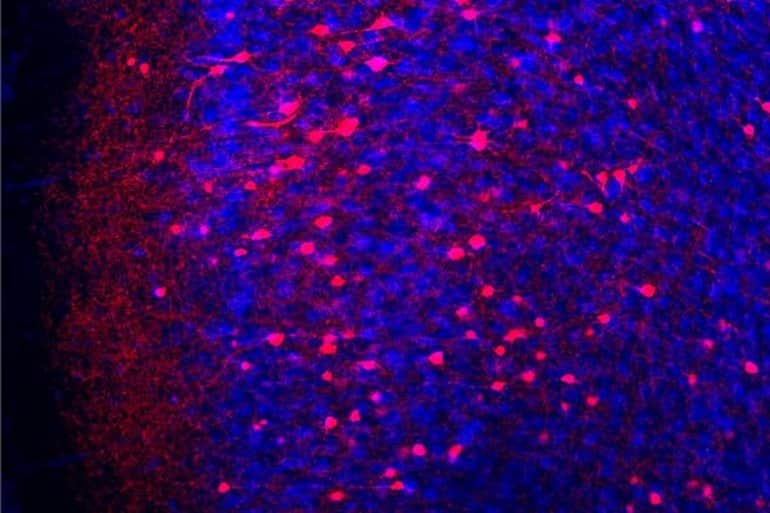
	<content type="html"><![CDATA[<a href="https://neurosciencenews.com/fear-memory-22134/" title="How the Brain Stores Remote Fear Memory" rel="noopener noreferrer" target="_blank"><img src="https://neurosciencenews.com/files/2022/12/fear-memory-neurosicnes-.jpg" alt="This shows neurons in the pfc" decoding="async" link_thumbnail="1" loading="lazy" srcset="https://neurosciencenews.com/files/2022/12/fear-memory-neurosicnes-.jpg 770w,https://neurosciencenews.com/files/2022/12/fear-memory-neurosicnes--300x200.jpg 300w,https://neurosciencenews.com/files/2022/12/fear-memory-neurosicnes--370x247.jpg 370w,https://neurosciencenews.com/files/2022/12/fear-memory-neurosicnes--293x195.jpg 293w,https://neurosciencenews.com/files/2022/12/fear-memory-neurosicnes--150x100.jpg 150w" sizes="(max-width: 770px) 100vw, 770px" referrerpolicy="no-referrer"></a>Remote fear memories, or memories of trauma formed in the distant past, are stored in the connections between neurons in the prefrontal cortex.]]></content>
	<updated>2022-12-23T20:14:28+00:00</updated>
	<author><name>Neuroscience News</name></author>
	<source>
		<id>http://neurosciencenews.com</id>
		<link rel="self" href="http://neurosciencenews.com"/>
		<updated>2022-12-23T20:14:28+00:00</updated>
		<title>Neuroscience RSS Feeds - Neuroscience News Updates</title></source>

	<category term="brain research"/>

	<category term="electrophysiology"/>

	<category term="fear memory"/>

	<category term="featured"/>

	<category term="memory"/>

	<category term="memory consolidation"/>

	<category term="neurobiology"/>

	<category term="neuroscience"/>

	<category term="prefrontal cortex"/>

	<category term="ptsd"/>

	<category term="ucr"/>


</entry>

<entry>
	<id>tag:gate.ccdw.org,2022-11-28:/1834454</id>
	<link href="https://neurosciencenews.com/opcs-synaptic-pruning-21961/" rel="alternate" type="text/html"/>
	<title type="html">Scientists Capture Detailed Snapshots of Mouse Brain Cells Nibbling on Neurons</title>
	<summary type="html"><![CDATA[Oligodendrocyte precursor cells (OPCs) play a significant role in synaptic pruning, a new study reve...]]></summary>
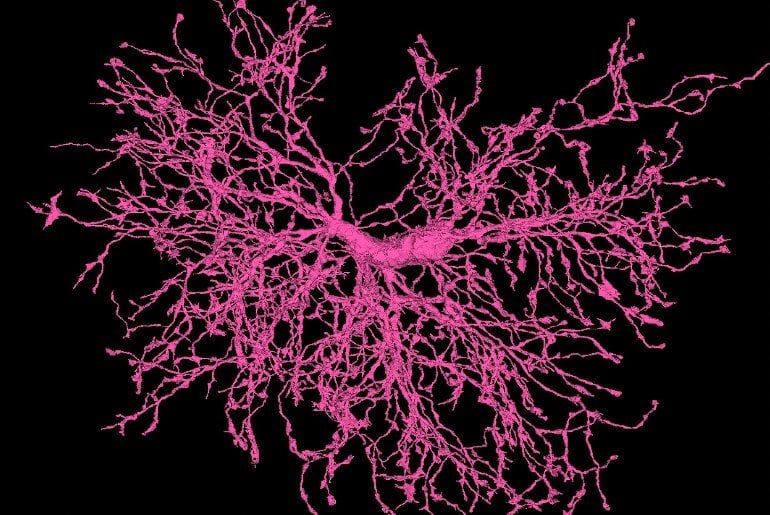
	<content type="html"><![CDATA[<a href="https://neurosciencenews.com/opcs-synaptic-pruning-21961/" title="Scientists Capture Detailed Snapshots of Mouse Brain Cells Nibbling on Neurons" rel="noopener noreferrer" target="_blank"><img src="https://neurosciencenews.com/files/2022/11/oligodendrocytes-neurosinces.jpg" alt="This shows oligodendrocyte precursor cells" decoding="async" link_thumbnail="1" srcset="https://neurosciencenews.com/files/2022/11/oligodendrocytes-neurosinces.jpg 770w,https://neurosciencenews.com/files/2022/11/oligodendrocytes-neurosinces-300x201.jpg 300w,https://neurosciencenews.com/files/2022/11/oligodendrocytes-neurosinces-370x247.jpg 370w,https://neurosciencenews.com/files/2022/11/oligodendrocytes-neurosinces-293x196.jpg 293w,https://neurosciencenews.com/files/2022/11/oligodendrocytes-neurosinces-150x100.jpg 150w" sizes="(max-width: 770px) 100vw, 770px" referrerpolicy="no-referrer" loading="lazy"></a>Oligodendrocyte precursor cells (OPCs) play a significant role in synaptic pruning, a new study reveals.]]></content>
	<updated>2022-11-28T22:52:32+00:00</updated>
	<author><name>Neuroscience News</name></author>
	<source>
		<id>http://neurosciencenews.com</id>
		<link rel="self" href="http://neurosciencenews.com"/>
		<updated>2022-11-28T22:52:32+00:00</updated>
		<title>Neuroscience RSS Feeds - Neuroscience News Updates</title></source>

	<category term="allen institute for brain science"/>

	<category term="brain research"/>

	<category term="electrophysiology"/>

	<category term="featured"/>

	<category term="neurobiology"/>

	<category term="neuroscience"/>

	<category term="oligodendrocyte precursor cells"/>

	<category term="oligodendrocytes"/>

	<category term="opcs"/>

	<category term="synaptic plasticity"/>


</entry>

<entry>
	<id>tag:gate.ccdw.org,2022-11-28:/1834414</id>
	<link href="https://neurosciencenews.com/octopus-nervous-system-21958/" rel="alternate" type="text/html"/>
	<title type="html">Unique Features of Octopus Create an Entirely New Way of Designing a Nervous System</title>
	<summary type="html"><![CDATA[Researchers discovered a structure within the octopus nervous system by which the intramuscular nerv...]]></summary>
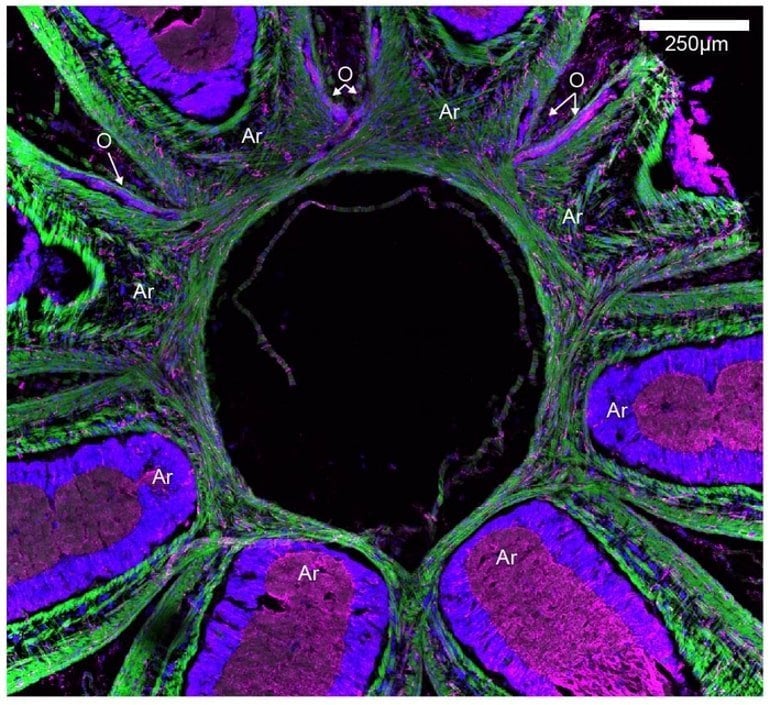
	<content type="html"><![CDATA[<a href="https://neurosciencenews.com/octopus-nervous-system-21958/" title="Unique Features of Octopus Create an Entirely New Way of Designing a Nervous System" rel="noopener noreferrer" target="_blank"><img src="https://neurosciencenews.com/files/2022/11/octopus-cns-neurosinces.jpg" alt="This shows a slice of the octopus body" decoding="async" link_thumbnail="1" loading="lazy" srcset="https://neurosciencenews.com/files/2022/11/octopus-cns-neurosinces.jpg 770w,https://neurosciencenews.com/files/2022/11/octopus-cns-neurosinces-300x275.jpg 300w,https://neurosciencenews.com/files/2022/11/octopus-cns-neurosinces-293x268.jpg 293w,https://neurosciencenews.com/files/2022/11/octopus-cns-neurosinces-150x137.jpg 150w" sizes="(max-width: 770px) 100vw, 770px" referrerpolicy="no-referrer"></a>Researchers discovered a structure within the octopus nervous system by which the intramuscular nerve cords, which help the cephalopod to sense its arm movements, connect arms on the opposite side of the animal.]]></content>
	<updated>2022-11-28T21:39:29+00:00</updated>
	<author><name>Neuroscience News</name></author>
	<source>
		<id>http://neurosciencenews.com</id>
		<link rel="self" href="http://neurosciencenews.com"/>
		<updated>2022-11-28T21:39:29+00:00</updated>
		<title>Neuroscience RSS Feeds - Neuroscience News Updates</title></source>

	<category term="brain research"/>

	<category term="central nervous system"/>

	<category term="cns"/>

	<category term="complex nervous system"/>

	<category term="featured"/>

	<category term="intramuscular nerve cords"/>

	<category term="neurobiology"/>

	<category term="neuroscience"/>

	<category term="open access"/>

	<category term="open neuroscience articles"/>

	<category term="open science"/>

	<category term="university of chicago"/>


</entry>

<entry>
	<id>tag:gate.ccdw.org,2022-10-13:/1810210</id>
	<link href="https://www.sciencedaily.com/releases/2022/10/221012132528.htm" rel="alternate" type="text/html"/>
	<title type="html">Human brain cells in a dish learn to play Pong in real time -- ScienceDaily</title>
	<summary type="html"><![CDATA[Human and mouse neurons in a dish learned to play the video game Pong, researchers report. The exper...]]></summary>
	<content type="html"><![CDATA[Human and mouse neurons in a dish learned to play the video game Pong, researchers report. The experiments are evidence that even brain cells in a dish can exhibit inherent intelligence, modifying their behavior over time.]]></content>
	<updated>2022-10-13T01:52:24+00:00</updated>
	<author><name></name></author>
	<source>
		<id>https://gate.ccdw.org/tt-rss</id>
		<link rel="self" href="https://gate.ccdw.org/tt-rss"/>
		<updated>2022-10-13T01:52:24+00:00</updated>
		<title>neuro</title></source>


</entry>

<entry>
	<id>tag:gate.ccdw.org,2022-09-06:/1790774</id>
	<link href="https://www.nature.com/articles/s41592-022-01613-0" rel="alternate" type="text/html"/>
	<title type="html">Neuroscience data analysis in the cloud</title>
	<summary type="html"><![CDATA[]]></summary>
	<content type="html"><![CDATA[]]></content>
	<updated>2022-09-06T00:00:00+00:00</updated>
	<author><name>Nina Vogt</name></author>
	<source>
		<id>https://www.nature.com/subjects/computational-neuroscience.atom/</id>
		<link rel="self" href="https://www.nature.com/subjects/computational-neuroscience.atom/"/>
		<updated>2022-09-06T00:00:00+00:00</updated>
		<title>Computational neuroscience : nature.com subject feeds</title></source>


</entry>

<entry>
	<id>tag:gate.ccdw.org,2022-09-01:/1788075</id>
	<link href="https://www.vice.com/en/article/3adam9/neurons-produce-the-direction-of-time-mind-bending-study-suggests" rel="alternate" type="text/html"/>
	<title type="html">Scientists Break the Direction of Time Down to the Cellular Level in Mind-Bending Study</title>
	<summary type="html"><![CDATA[The passage of time is a universal facet of life. But what is time, and why do we experience it as s...]]></summary>
	<content type="html"><![CDATA[The passage of time is a universal facet of life. But what is time, and why do we experience it as something that has direction, with a past and a future? In a new study, scientists have broken down this "arrow of time" to a microscopic physical level.]]></content>
	<updated>2022-09-01T02:42:19+00:00</updated>
	<author><name></name></author>
	<source>
		<id>https://gate.ccdw.org/tt-rss</id>
		<link rel="self" href="https://gate.ccdw.org/tt-rss"/>
		<updated>2022-09-01T02:42:19+00:00</updated>
		<title>neuro</title></source>


</entry>

<entry>
	<id>tag:gate.ccdw.org,2022-06-15:/1746297</id>
	<link href="https://www.frontiersin.org/articles/10.3389/fncom.2022.898829" rel="alternate" type="text/html"/>
	<title type="html">Time Is of the Essence: Neural Codes, Synchronies, Oscillations, Architectures</title>
	<summary type="html"><![CDATA[Time is of the essence in how neural codes, synchronies, and oscillations might function in encoding...]]></summary>
	<content type="html"><![CDATA[<p>Time is of the essence in how neural codes, synchronies, and oscillations might function in encoding, representation, transmission, integration, storage, and retrieval of information in brains. This Hypothesis and Theory article examines observed and possible relations between codes, synchronies, oscillations, and types of neural networks they require. Toward reverse-engineering informational functions in brains, prospective, alternative neural architectures incorporating principles from radio modulation and demodulation, active reverberant circuits, distributed content-addressable memory, signal-signal time-domain correlation and convolution operations, spike-correlation-based holography, and self-organizing, autoencoding anticipatory systems are outlined. Synchronies and oscillations are thought to subserve many possible functions: sensation, perception, action, cognition, motivation, affect, memory, attention, anticipation, and imagination. These include direct involvement in coding attributes of events and objects through phase-locking as well as characteristic patterns of spike latency and oscillatory response. They are thought to be involved in segmentation and binding, working memory, attention, gating and routing of signals, temporal reset mechanisms, inter-regional coordination, time discretization, time-warping transformations, and support for temporal wave-interference based operations. A high level, partial taxonomy of neural codes consists of channel, temporal pattern, and spike latency codes. The functional roles of synchronies and oscillations in candidate neural codes, including oscillatory phase-offset codes, are outlined. Various forms of multiplexing neural signals are considered: time-division, frequency-division, code-division, oscillatory-phase, synchronized channels, oscillatory hierarchies, polychronous ensembles. An expandable, annotative neural spike train framework for encoding low- and high-level attributes of events and objects is proposed. Coding schemes require appropriate neural architectures for their interpretation. Time-delay, oscillatory, wave-interference, synfire chain, polychronous, and neural timing networks are discussed. Some novel concepts for formulating an alternative, more time-centric theory of brain function are discussed. As in radio communication systems, brains can be regarded as networks of dynamic, adaptive transceivers that broadcast and selectively receive multiplexed temporally-patterned pulse signals. These signals enable complex signal interactions that select, reinforce, and bind common subpatterns and create emergent lower dimensional signals that propagate through spreading activation interference networks. If memory traces share the same kind of temporal pattern forms as do active neuronal representations, then distributed, holograph-like content-addressable memories are made possible via temporal pattern resonances.</p>]]></content>
	<updated>2022-07-10T14:51:23+00:00</updated>
	<author><name>Peter Cariani</name></author>
	<source>
		<id>https://www.frontiersin.org/journals/computational-neuroscience</id>
		<link rel="self" href="https://www.frontiersin.org/journals/computational-neuroscience"/>
		<updated>2022-07-10T14:51:23+00:00</updated>
		<title>Frontiers in Computational Neuroscience | New and Recent Articles</title></source>


</entry>

<entry>
	<id>tag:gate.ccdw.org,2022-05-30:/1737533</id>
	<link href="http://arxiv.org/abs/2205.13614" rel="alternate" type="text/html"/>
	<title type="html">Emergent organization of receptive fields in networks of excitatory and inhibitory neurons. (arXiv:2205.13614v1 [q-bio.NC])</title>
	<summary type="html"><![CDATA[Local patterns of excitation and inhibition that can generate neural waves
are studied as a computat...]]></summary>
	<content type="html"><![CDATA[<p>Local patterns of excitation and inhibition that can generate neural waves
are studied as a computational mechanism underlying the organization of
neuronal tunings. Sparse coding algorithms based on networks of excitatory and
inhibitory neurons are proposed that exhibit topographic maps as the receptive
fields are adapted to input stimuli. Motivated by a leaky integrate-and-fire
model of neural waves, we propose an activation model that is more typical of
artificial neural networks. Computational experiments with the activation model
using both natural images and natural language text are presented. In the case
of images, familiar "pinwheel" patterns of oriented edge detectors emerge; in
the case of text, the resulting topographic maps exhibit a 2-dimensional
representation of granular word semantics. Experiments with a synthetic model
of somatosensory input are used to investigate how the network dynamics may
affect plasticity of neuronal maps under changes to the inputs.
</p>]]></content>
	<updated>2022-05-30T12:37:51+00:00</updated>
	<author><name>Leon Lufkin, Ashish Puri, Ganlin Song, Xinyi Zhong, John Lafferty</name></author>
	<source>
		<id>http://arxiv.org/</id>
		<link rel="self" href="http://arxiv.org/"/>
		<updated>2022-05-30T12:37:51+00:00</updated>
		<title>q-bio updates on arXiv.org</title></source>


</entry>

<entry>
	<id>tag:gate.ccdw.org,2022-05-20:/1732136</id>
	<link href="https://www.frontiersin.org/articles/10.3389/fncom.2022.882290" rel="alternate" type="text/html"/>
	<title type="html">Deep Residual Convolutional Neural Networks for Brain–Computer Interface to Visualize Neural Processing of Hand Movements in the Human Brain</title>
	<summary type="html"><![CDATA[Concomitant with the development of deep learning, brain–computer interface (BCI) decoding technolog...]]></summary>
	<content type="html"><![CDATA[<p>Concomitant with the development of deep learning, brain–computer interface (BCI) decoding technology has been rapidly evolving. Convolutional neural networks (CNNs), which are generally used as electroencephalography (EEG) classification models, are often deployed in BCI prototypes to improve the estimation accuracy of a participant's brain activity. However, because most BCI models are trained, validated, and tested  within-subject cross-validation and there is no corresponding generalization model, their applicability to unknown participants is not guaranteed. In this study, to facilitate the generalization of BCI model performance to unknown participants, we trained a model comprising multiple layers of residual CNNs and visualized the reasons for BCI classification to reveal the location and timing of neural activities that contribute to classification. Specifically, to develop a BCI that can distinguish between rest, left-hand movement, and right-hand movement tasks with high accuracy, we created multilayers of CNNs, inserted residual networks into the multilayers, and used a larger dataset than in previous studies. The constructed model was analyzed with gradient-class activation mapping (Grad-CAM). We evaluated the developed model  subject cross-validation and found that it achieved significantly improved accuracy (85.69 ± 1.10%) compared with conventional models or without residual networks. Grad-CAM analysis of the classification of cases in which our model produced correct answers showed localized activity near the premotor cortex. These results confirm the effectiveness of inserting residual networks into CNNs for tuning BCI. Further, they suggest that recording EEG signals over the premotor cortex and some other areas contributes to high classification accuracy.</p>]]></content>
	<updated>2022-05-21T05:27:36+00:00</updated>
	<author><name>Yosuke Fujiwara</name></author>
	<source>
		<id>https://www.frontiersin.org/journals/computational-neuroscience</id>
		<link rel="self" href="https://www.frontiersin.org/journals/computational-neuroscience"/>
		<updated>2022-05-21T05:27:36+00:00</updated>
		<title>Frontiers in Computational Neuroscience | New and Recent Articles</title></source>


</entry>

<entry>
	<id>tag:gate.ccdw.org,2022-05-16:/1729452</id>
	<link href="http://arxiv.org/abs/2205.06313" rel="alternate" type="text/html"/>
	<title type="html">Detailed Balanced Chemical Reaction Networks as Generalized Boltzmann Machines. (arXiv:2205.06313v1 [q-bio.MN])</title>
	<summary type="html"><![CDATA[Can a micron sized sack of interacting molecules understand, and adapt to a
constantly-fluctuating e...]]></summary>
	<content type="html"><![CDATA[<p>Can a micron sized sack of interacting molecules understand, and adapt to a
constantly-fluctuating environment? Cellular life provides an existence proof
in the affirmative, but the principles that allow for life's existence are far
from being proven. One challenge in engineering and understanding biochemical
computation is the intrinsic noise due to chemical fluctuations. In this paper,
we draw insights from machine learning theory, chemical reaction network
theory, and statistical physics to show that the broad and biologically
relevant class of detailed balanced chemical reaction networks is capable of
representing and conditioning complex distributions. These results illustrate
how a biochemical computer can use intrinsic chemical noise to perform complex
computations. Furthermore, we use our explicit physical model to derive
thermodynamic costs of inference.
</p>]]></content>
	<updated>2022-05-16T12:38:42+00:00</updated>
	<author><name>William Poole, Thomas Ouldridge, Manoj Gopalkrishnan, Erik Winfree</name></author>
	<source>
		<id>http://arxiv.org/</id>
		<link rel="self" href="http://arxiv.org/"/>
		<updated>2022-05-16T12:38:42+00:00</updated>
		<title>q-bio updates on arXiv.org</title></source>


</entry>

<entry>
	<id>tag:gate.ccdw.org,2022-05-06:/1723610</id>
	<link href="https://www.nature.com/articles/s41598-022-10466-8" rel="alternate" type="text/html"/>
	<title type="html">Efficient dendritic learning as an alternative to synaptic plasticity hypothesis | Scientific Reports</title>
	<summary type="html"><![CDATA[Synaptic plasticity is a long-lasting core hypothesis of brain learning that suggests local adaptati...]]></summary>
	<content type="html"><![CDATA[Synaptic plasticity is a long-lasting core hypothesis of brain learning that suggests local adaptation between two connecting neurons and forms the foundation of machine learning. The main complexity of synaptic plasticity is that synapses and dendrites connect neurons in series and existing experiments cannot pinpoint the significant imprinted adaptation location. We showed efficient backpropagation and Hebbian learning on dendritic trees, inspired by experimental-based evidence, for sub-dendritic adaptation and its nonlinear amplification. It has proven to achieve success rates approaching unity for handwritten digits recognition, indicating realization of deep learning even by a single dendrite or neuron. Additionally, dendritic amplification practically generates an exponential number of input crosses, higher-order interactions, with the number of inputs, which enhance success rates. However, direct implementation of a large number of the cross weights and their exhaustive manipulation independently is beyond existing and anticipated computational power. Hence, a new type of nonlinear adaptive dendritic hardware for imitating dendritic learning and estimating the computational capability of the brain must be built.]]></content>
	<updated>2022-05-06T01:52:43+00:00</updated>
	<author><name></name></author>
	<source>
		<id>https://gate.ccdw.org/tt-rss</id>
		<link rel="self" href="https://gate.ccdw.org/tt-rss"/>
		<updated>2022-05-06T01:52:43+00:00</updated>
		<title>neuro</title></source>


</entry>

<entry>
	<id>tag:gate.ccdw.org,2022-05-01:/1721491</id>
	<link href="https://neurosciencenews.com/high-static-magnetic-field-anxiety-20503/" rel="alternate" type="text/html"/>
	<title type="html">High Static Magnetic Field Can Relieve Anxiety</title>
	<summary type="html"><![CDATA[Exposure to high static magnetic fields alleviated anxiety and improved both spatial and social memo...]]></summary>
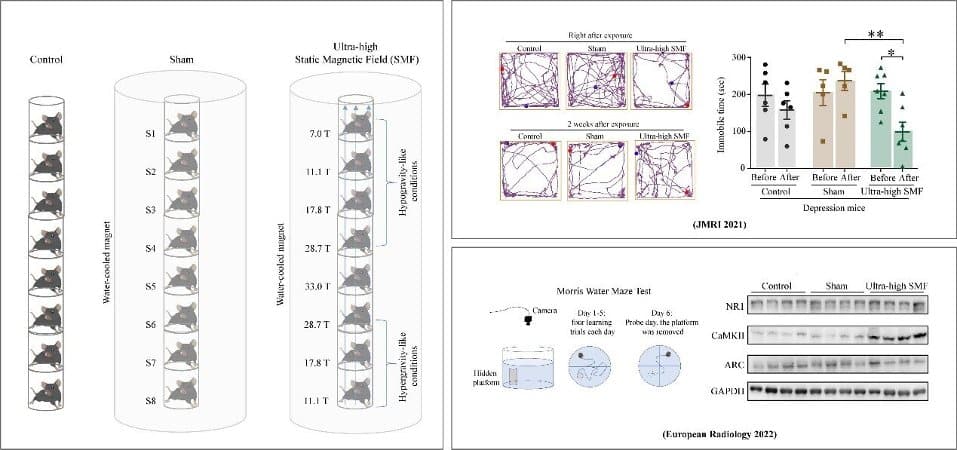
	<content type="html"><![CDATA[<a href="https://neurosciencenews.com/high-static-magnetic-field-anxiety-20503/" title="High Static Magnetic Field Can Relieve Anxiety" rel="noopener noreferrer" target="_blank"><img src="https://neurosciencenews.com/files/2022/05/static-magnetic-anxiety-neurosciences-.jpg" alt="This shows a diagram from the study" link_thumbnail="1" loading="lazy" srcset="https://neurosciencenews.com/files/2022/05/static-magnetic-anxiety-neurosciences-.jpg 957w,https://neurosciencenews.com/files/2022/05/static-magnetic-anxiety-neurosciences--300x141.jpg 300w,https://neurosciencenews.com/files/2022/05/static-magnetic-anxiety-neurosciences--770x362.jpg 770w,https://neurosciencenews.com/files/2022/05/static-magnetic-anxiety-neurosciences--293x138.jpg 293w,https://neurosciencenews.com/files/2022/05/static-magnetic-anxiety-neurosciences--150x71.jpg 150w" sizes="(max-width: 957px) 100vw, 957px" referrerpolicy="no-referrer"></a>Exposure to high static magnetic fields alleviated anxiety and improved both spatial and social memory in mice within two months of exposure.]]></content>
	<updated>2022-05-01T21:00:17+00:00</updated>
	<author><name>Neuroscience News</name></author>
	<source>
		<id>http://neurosciencenews.com</id>
		<link rel="self" href="http://neurosciencenews.com"/>
		<updated>2022-05-01T21:00:17+00:00</updated>
		<title>Neuroscience RSS Feeds - Neuroscience News Updates</title></source>

	<category term="anxiety"/>

	<category term="brain research"/>

	<category term="chinese academy of science"/>

	<category term="featured"/>

	<category term="mental health"/>

	<category term="neurobiology"/>

	<category term="neuroscience"/>

	<category term="neurotech"/>

	<category term="psychology"/>

	<category term="shmff"/>

	<category term="static magnetic field"/>


</entry>

<entry>
	<id>tag:gate.ccdw.org,2022-04-18:/1714508</id>
	<link href="https://neurosciencenews.com/brain-model-response-20395/" rel="alternate" type="text/html"/>
	<title type="html">Simple, Computationally-Light Model Can Simulate Complex Brain Cell Responses</title>
	<summary type="html"><![CDATA[The Izhikevich neuron model allows the simulation of both periodic and quasi-periodic responses in n...]]></summary>
	<content type="html"><![CDATA[<a href="https://neurosciencenews.com/brain-model-response-20395/" title="Simple, Computationally-Light Model Can Simulate Complex Brain Cell Responses" rel="noopener noreferrer" target="_blank"><img src="https://neurosciencenews.com/files/2022/04/light-model-brain-cell-neurosinces-.jpg" alt="This shows a neuron" link_thumbnail="1" loading="lazy" srcset="https://neurosciencenews.com/files/2022/04/light-model-brain-cell-neurosinces-.jpg 770w,https://neurosciencenews.com/files/2022/04/light-model-brain-cell-neurosinces--300x200.jpg 300w,https://neurosciencenews.com/files/2022/04/light-model-brain-cell-neurosinces--370x247.jpg 370w,https://neurosciencenews.com/files/2022/04/light-model-brain-cell-neurosinces--293x195.jpg 293w,https://neurosciencenews.com/files/2022/04/light-model-brain-cell-neurosinces--150x100.jpg 150w" sizes="(max-width: 770px) 100vw, 770px" referrerpolicy="no-referrer"></a>The Izhikevich neuron model allows the simulation of both periodic and quasi-periodic responses in neurons at lower computational cost.]]></content>
	<updated>2022-04-18T19:48:16+00:00</updated>
	<author><name>Neuroscience News</name></author>
	<source>
		<id>http://neurosciencenews.com</id>
		<link rel="self" href="http://neurosciencenews.com"/>
		<updated>2022-04-18T19:48:16+00:00</updated>
		<title>Neuroscience RSS Feeds - Neuroscience News Updates</title></source>

	<category term="brain research"/>

	<category term="featured"/>

	<category term="izhikevich neuron model"/>

	<category term="neurobiology"/>

	<category term="neuroscience"/>

	<category term="sinusoidal input"/>

	<category term="tokyo university of science"/>


</entry>

<entry>
	<id>tag:gate.ccdw.org,2022-03-10:/1694835</id>
	<link href="https://neurosciencenews.com/controllability-neuroscience-20167/" rel="alternate" type="text/html"/>
	<title type="html">How Does the Brain Know Whether Our Actions Actually Make a Difference?</title>
	<summary type="html"><![CDATA[Findings reveal how the brain calculates controllability based on neural activity and behavior.]]></summary>

	<content type="html"><![CDATA[<a href="https://neurosciencenews.com/controllability-neuroscience-20167/" title="How Does the Brain Know Whether Our Actions Actually Make a Difference?" rel="noopener noreferrer" target="_blank"><img src="https://neurosciencenews.com/files/2022/03/actions-difference-neurosinces.jpg" alt="This shows a lot of doors leading to different areas of a house" link_thumbnail="1" loading="lazy" srcset="https://neurosciencenews.com/files/2022/03/actions-difference-neurosinces.jpg 1093w,https://neurosciencenews.com/files/2022/03/actions-difference-neurosinces-300x137.jpg 300w,https://neurosciencenews.com/files/2022/03/actions-difference-neurosinces-770x352.jpg 770w,https://neurosciencenews.com/files/2022/03/actions-difference-neurosinces-293x134.jpg 293w,https://neurosciencenews.com/files/2022/03/actions-difference-neurosinces-150x69.jpg 150w" sizes="(max-width: 1093px) 100vw, 1093px" referrerpolicy="no-referrer"></a>Findings reveal how the brain calculates controllability based on neural activity and behavior.]]></content>
	<updated>2022-03-10T20:34:45+00:00</updated>
	<author><name>Neuroscience News</name></author>
	<source>
		<id>http://neurosciencenews.com</id>
		<link rel="self" href="http://neurosciencenews.com"/>
		<updated>2022-03-10T20:34:45+00:00</updated>
		<title>Neuroscience RSS Feeds - Neuroscience News Updates</title></source>

	<category term="brain research"/>

	<category term="champalimaud centre for the unknown"/>

	<category term="cognition"/>

	<category term="control"/>

	<category term="controllabilty"/>

	<category term="featured"/>

	<category term="learning"/>

	<category term="neurobiology"/>

	<category term="neuroscience"/>

	<category term="stress"/>


</entry>

<entry>
	<id>tag:gate.ccdw.org,2022-01-25:/1672869</id>
	<link href="https://www.frontiersin.org/articles/10.3389/fncom.2021.783474" rel="alternate" type="text/html"/>
	<title type="html">Short- and Long-Range Connections Differentially Modulate the Dynamics and State of Small-World Networks</title>
	<summary type="html"><![CDATA[The human brain contains billions of neurons that flexibly interconnect to support local and global ...]]></summary>
	<content type="html"><![CDATA[<p>The human brain contains billions of neurons that flexibly interconnect to support local and global computational spans. As neuronal activity propagates through the neural medium, it approaches a critical state hedged between ordered and disordered system regimes. Recent work demonstrates that this criticality coincides with the small-world topology, a network arrangement that accommodates both local (subcritical) and global (supercritical) system properties. On one hand, operating near criticality is thought to offer several neurocomputational advantages, e.g., high-dynamic range, efficient information capacity, and information transfer fidelity. On the other hand, aberrations from the critical state have been linked to diverse pathologies of the brain, such as post-traumatic epileptiform seizures and disorders of consciousness. Modulation of brain activity, through neuromodulation, presents an attractive mode of treatment to alleviate such neurological disorders, but a tractable neural framework is needed to facilitate clinical progress. Using a variation on the generative small-world model of Watts and Strogatz and Kuramoto's model of coupled oscillators, we show that the topological and dynamical properties of the small-world network are divided into two functional domains based on the range of connectivity, and that these domains play distinct roles in shaping the behavior of the critical state. We demonstrate that short-range network connections shape the dynamics of the system, e.g., its volatility and metastability, whereas long-range connections drive the system state, e.g., a seizure. Together, these findings lend support to combinatorial neuromodulation approaches that synergistically normalize the system dynamic while mobilizing the system state.</p>]]></content>
	<updated>2022-01-25T04:42:29+00:00</updated>
	<author><name>Simon Arvin</name></author>
	<source>
		<id>https://www.frontiersin.org/journals/computational-neuroscience</id>
		<link rel="self" href="https://www.frontiersin.org/journals/computational-neuroscience"/>
		<updated>2022-01-25T04:42:29+00:00</updated>
		<title>Frontiers in Computational Neuroscience | New and Recent Articles</title></source>


</entry>

<entry>
	<id>tag:gate.ccdw.org,2021-12-03:/1644652</id>
	<link href="https://neurosciencenews.com/synaptic-vesicle-metabolism-19745/" rel="alternate" type="text/html"/>
	<title type="html">Why Neurons Consume So Much Fuel Even When at Rest</title>
	<summary type="html"><![CDATA[Synaptic vesicles are a major source of energy consumption in inactive neurons, a new study reports.]]></summary>
	<content type="html"><![CDATA[<a href="https://neurosciencenews.com/synaptic-vesicle-metabolism-19745/" title="Why Neurons Consume So Much Fuel Even When at Rest" rel="noopener noreferrer" target="_blank"><img src="https://neurosciencenews.com/files/2021/12/neuron-energy-rest-neurosinces-public.jpg" alt="This shows a head with a question mark" link_thumbnail="1" srcset="https://neurosciencenews.com/files/2021/12/neuron-energy-rest-neurosinces-public.jpg 770w,https://neurosciencenews.com/files/2021/12/neuron-energy-rest-neurosinces-public-300x200.jpg 300w,https://neurosciencenews.com/files/2021/12/neuron-energy-rest-neurosinces-public-370x247.jpg 370w,https://neurosciencenews.com/files/2021/12/neuron-energy-rest-neurosinces-public-293x195.jpg 293w,https://neurosciencenews.com/files/2021/12/neuron-energy-rest-neurosinces-public-150x100.jpg 150w" sizes="(max-width: 770px) 100vw, 770px" referrerpolicy="no-referrer" loading="lazy"></a>Synaptic vesicles are a major source of energy consumption in inactive neurons, a new study reports.]]></content>
	<updated>2021-12-03T22:35:45+00:00</updated>
	<author><name>Neuroscience News</name></author>
	<source>
		<id>http://neurosciencenews.com</id>
		<link rel="self" href="http://neurosciencenews.com"/>
		<updated>2021-12-03T22:35:45+00:00</updated>
		<title>Neuroscience RSS Feeds - Neuroscience News Updates</title></source>

	<category term="brain research"/>

	<category term="featured"/>

	<category term="metabolism"/>

	<category term="neurobiology"/>

	<category term="neuroscience"/>

	<category term="neurotransmission"/>

	<category term="proton pump"/>

	<category term="synaptic vesicles"/>

	<category term="weill cornell university"/>


</entry>

<entry>
	<id>tag:gate.ccdw.org,2021-08-22:/1599415</id>
	<link href="http://feedproxy.google.com/~r/neuroscience-rss-feeds-neuroscience-news/~3/5rdf9O4XaV4/" rel="alternate" type="text/html"/>
	<title type="html">Neural Network Models of the Future – The Key to Unlocking How Our Brain Works</title>
	<summary type="html"><![CDATA[Researchers discuss different current neural network models and consider the steps that need to be t...]]></summary>
	<content type="html"><![CDATA[<a href="https://neurosciencenews.com/neural-network-future-19171/" title="Neural Network Models of the Future – The Key to Unlocking How Our Brain Works" rel="noopener noreferrer" target="_blank"><img src="https://neurosciencenews.com/files/2021/08/neural-network-future-neurisceinces-public.jpg" alt="This shows a brain" link_thumbnail="1" srcset="https://neurosciencenews.com/files/2021/08/neural-network-future-neurisceinces-public.jpg 770w,https://neurosciencenews.com/files/2021/08/neural-network-future-neurisceinces-public-300x200.jpg 300w,https://neurosciencenews.com/files/2021/08/neural-network-future-neurisceinces-public-370x247.jpg 370w,https://neurosciencenews.com/files/2021/08/neural-network-future-neurisceinces-public-293x195.jpg 293w,https://neurosciencenews.com/files/2021/08/neural-network-future-neurisceinces-public-150x100.jpg 150w" sizes="(max-width: 770px) 100vw, 770px" referrerpolicy="no-referrer" loading="lazy"></a>Researchers discuss different current neural network models and consider the steps that need to be taken to make them more realistic, and thus more useful, as possible.<img src="http://feeds.feedburner.com/~r/neuroscience-rss-feeds-neuroscience-news/~4/5rdf9O4XaV4" alt="" referrerpolicy="no-referrer" loading="lazy">]]></content>
	<updated>2021-08-22T00:07:40+00:00</updated>
	<author><name>Neuroscience News</name></author>
	<source>
		<id>http://neurosciencenews.com</id>
		<link rel="self" href="http://neurosciencenews.com"/>
		<updated>2021-08-22T00:07:40+00:00</updated>
		<title>Neuroscience RSS Feeds - Neuroscience News Updates</title></source>

	<category term="aans"/>

	<category term="ai"/>

	<category term="artificial intelligence"/>

	<category term="artificial neural networks"/>

	<category term="brain research"/>

	<category term="deep learning"/>

	<category term="featured"/>

	<category term="machine learning"/>

	<category term="neural networks"/>

	<category term="neurobiology"/>

	<category term="neuroscience"/>

	<category term="university of plymouth"/>


</entry>

<entry>
	<id>tag:gate.ccdw.org,2021-08-09:/1594475</id>
	<link href="http://feedproxy.google.com/~r/neuroscience-rss-feeds-neuroscience-news/~3/HdMDGOxiJY8/" rel="alternate" type="text/html"/>
	<title type="html">Brain Connectivity Can Build Better AI</title>
	<summary type="html"><![CDATA[Artificial neural networks modeled on human brain connectivity can effectively perform complex cogni...]]></summary>
	<content type="html"><![CDATA[<a href="https://neurosciencenews.com/ai-brain-connectivity-19088/" title="Brain Connectivity Can Build Better AI" rel="noopener noreferrer" target="_blank"><img src="https://neurosciencenews.com/files/2021/08/brain-connectivity-ai-neurosinces-public-1155x770.jpg" alt="This shows a brain" link_thumbnail="1" srcset="https://neurosciencenews.com/files/2021/08/brain-connectivity-ai-neurosinces-public-1155x770.jpg 1155w,https://neurosciencenews.com/files/2021/08/brain-connectivity-ai-neurosinces-public-370x247.jpg 370w,https://neurosciencenews.com/files/2021/08/brain-connectivity-ai-neurosinces-public-770x513.jpg 770w" sizes="(max-width: 1155px) 100vw, 1155px" referrerpolicy="no-referrer" loading="lazy"></a>Artificial neural networks modeled on human brain connectivity can effectively perform complex cognitive tasks.<img src="http://feeds.feedburner.com/~r/neuroscience-rss-feeds-neuroscience-news/~4/HdMDGOxiJY8" alt="" referrerpolicy="no-referrer" loading="lazy">]]></content>
	<updated>2021-08-09T22:04:36+00:00</updated>
	<author><name>Neuroscience News</name></author>
	<source>
		<id>http://neurosciencenews.com</id>
		<link rel="self" href="http://neurosciencenews.com"/>
		<updated>2021-08-09T22:04:36+00:00</updated>
		<title>Neuroscience RSS Feeds - Neuroscience News Updates</title></source>

	<category term="aans"/>

	<category term="ai"/>

	<category term="artificial intelligence"/>

	<category term="artificial neural networks"/>

	<category term="brain connectivity"/>

	<category term="brain research"/>

	<category term="deep learning"/>

	<category term="featured"/>

	<category term="machine learning"/>

	<category term="mcgill university"/>

	<category term="neurobiology"/>

	<category term="neuroscience"/>


</entry>

<entry>
	<id>tag:gate.ccdw.org,2021-07-10:/1583307</id>
	<link href="http://feedproxy.google.com/~r/neuroscience-rss-feeds-neuroscience-news/~3/cWKNcAhhUbI/" rel="alternate" type="text/html"/>
	<title type="html">Cell Structure Previously Associated With Disease Actually Improves Brain Function</title>
	<summary type="html"><![CDATA[Axonal swelling in the Purkinje cells of mice had no detrimental impact on firing rate or the speed ...]]></summary>
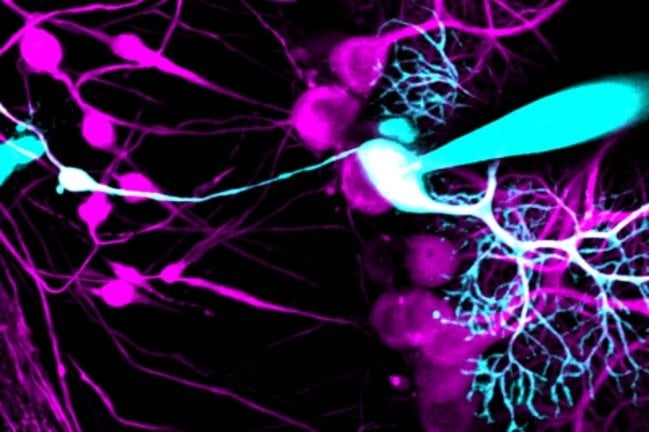
	<content type="html"><![CDATA[<a href="https://neurosciencenews.com/axon-swelling-purkinje-cells-18894/" title="Cell Structure Previously Associated With Disease Actually Improves Brain Function" rel="noopener noreferrer" target="_blank"><img src="https://neurosciencenews.com/files/2021/07/purkinje-cell-helpful-neurosciences.jpg" alt="This shows a purkinje cell" link_thumbnail="1" srcset="https://neurosciencenews.com/files/2021/07/purkinje-cell-helpful-neurosciences.jpg 649w,https://neurosciencenews.com/files/2021/07/purkinje-cell-helpful-neurosciences-300x200.jpg 300w,https://neurosciencenews.com/files/2021/07/purkinje-cell-helpful-neurosciences-370x247.jpg 370w,https://neurosciencenews.com/files/2021/07/purkinje-cell-helpful-neurosciences-293x195.jpg 293w,https://neurosciencenews.com/files/2021/07/purkinje-cell-helpful-neurosciences-150x100.jpg 150w" sizes="(max-width: 649px) 100vw, 649px" referrerpolicy="no-referrer" loading="lazy"></a>Axonal swelling in the Purkinje cells of mice had no detrimental impact on firing rate or the speed at which axons transmit signals. At peak firing rate, axons with swellings were less likely to fail than those without.<img src="http://feeds.feedburner.com/~r/neuroscience-rss-feeds-neuroscience-news/~4/cWKNcAhhUbI" alt="" referrerpolicy="no-referrer" loading="lazy">]]></content>
	<updated>2021-07-10T20:59:51+00:00</updated>
	<author><name>Neuroscience News</name></author>
	<source>
		<id>http://neurosciencenews.com</id>
		<link rel="self" href="http://neurosciencenews.com"/>
		<updated>2021-07-10T20:59:51+00:00</updated>
		<title>Neuroscience RSS Feeds - Neuroscience News Updates</title></source>

	<category term="axonal swelling"/>

	<category term="axons"/>

	<category term="brain research"/>

	<category term="cerebellum"/>

	<category term="electrophysiology"/>

	<category term="featured"/>

	<category term="mcgill university"/>

	<category term="neurobiology"/>

	<category term="neuroscience"/>

	<category term="open access"/>

	<category term="open neuroscience articles"/>

	<category term="open science"/>

	<category term="purkinje cells"/>


</entry>

<entry>
	<id>tag:gate.ccdw.org,2021-07-01:/1580068</id>
	<link href="http://feedproxy.google.com/~r/neuroscience-rss-feeds-neuroscience-news/~3/m35xfA9VE-o/" rel="alternate" type="text/html"/>
	<title type="html">Scientists Discover a New Class of Memory Cells in the Brain</title>
	<summary type="html"><![CDATA[Researchers have identified a novel population of neurons in the temporal pole that links facial per...]]></summary>
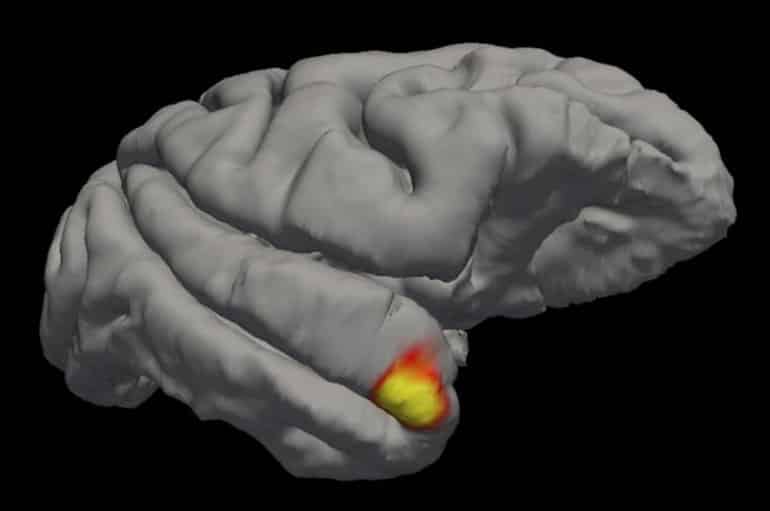
	<content type="html"><![CDATA[<a href="https://neurosciencenews.com/memory-neurons-temporal-pole-18847/" title="Scientists Discover a New Class of Memory Cells in the Brain" rel="noopener noreferrer" target="_blank"><img src="https://neurosciencenews.com/files/2021/07/new-memory-cells-neuroscienes.jpg" alt="This shows the brain area lit up" link_thumbnail="1" srcset="https://neurosciencenews.com/files/2021/07/new-memory-cells-neuroscienes.jpg 770w,https://neurosciencenews.com/files/2021/07/new-memory-cells-neuroscienes-300x199.jpg 300w,https://neurosciencenews.com/files/2021/07/new-memory-cells-neuroscienes-370x247.jpg 370w,https://neurosciencenews.com/files/2021/07/new-memory-cells-neuroscienes-293x194.jpg 293w,https://neurosciencenews.com/files/2021/07/new-memory-cells-neuroscienes-150x100.jpg 150w" sizes="(max-width: 770px) 100vw, 770px" referrerpolicy="no-referrer" loading="lazy"></a>Researchers have identified a novel population of neurons in the temporal pole that links facial perception to long-term memory.<img src="http://feeds.feedburner.com/~r/neuroscience-rss-feeds-neuroscience-news/~4/m35xfA9VE-o" alt="" referrerpolicy="no-referrer" loading="lazy">]]></content>
	<updated>2021-07-01T20:56:11+00:00</updated>
	<author><name>Neuroscience News</name></author>
	<source>
		<id>http://neurosciencenews.com</id>
		<link rel="self" href="http://neurosciencenews.com"/>
		<updated>2021-07-01T20:56:11+00:00</updated>
		<title>Neuroscience RSS Feeds - Neuroscience News Updates</title></source>

	<category term="brain research"/>

	<category term="featured"/>

	<category term="grandmother neurons"/>

	<category term="memory"/>

	<category term="neurobiology"/>

	<category term="neurons"/>

	<category term="neuroscience"/>

	<category term="rockefeller university"/>

	<category term="temporal pole"/>


</entry>

<entry>
	<id>tag:gate.ccdw.org,2021-06-29:/1578988</id>
	<link href="https://physics.aps.org/articles/v14/93?utm_campaign=weekly&amp;utm_medium=email&amp;utm_source=emailalert" rel="alternate" type="text/html"/>
	<title type="html">Physics - Statistical Mechanics Built on Sand</title>
	<summary type="html"><![CDATA[]]></summary>
	<content type="html"><![CDATA[]]></content>
	<updated>2021-06-29T06:43:57+00:00</updated>
	<author><name></name></author>
	<source>
		<id>https://gate.ccdw.org/tt-rss</id>
		<link rel="self" href="https://gate.ccdw.org/tt-rss"/>
		<updated>2021-06-29T06:43:57+00:00</updated>
		<title>neuro</title></source>


</entry>

<entry>
	<id>tag:gate.ccdw.org,2021-05-22:/1565182</id>
	<link href="http://feedproxy.google.com/~r/neuroscience-rss-feeds-neuroscience-news/~3/vfQi7C3y82Q/" rel="alternate" type="text/html"/>
	<title type="html">Fly Brains Make Predictions, Possibly Using Universal Design Principles</title>
	<summary type="html"><![CDATA[Findings suggest prediction may be a general feature of animal nervous systems in supporting quick b...]]></summary>
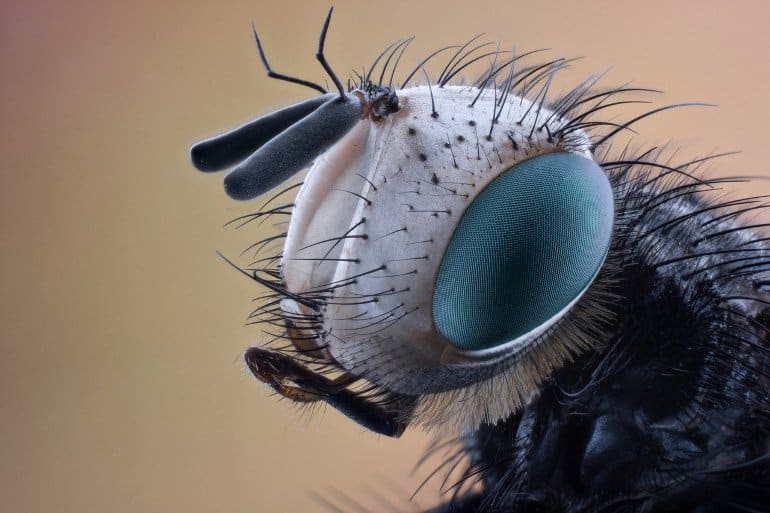
	<content type="html"><![CDATA[<a href="https://neurosciencenews.com/prediction-universal-design-principle-18473/" title="Fly Brains Make Predictions, Possibly Using Universal Design Principles" rel="noopener noreferrer" target="_blank"><img src="https://neurosciencenews.com/files/2021/05/fly-brain-prediction-neurosicnens-public.jpg" alt="This shows a close up of a fly's face" link_thumbnail="1" srcset="https://neurosciencenews.com/files/2021/05/fly-brain-prediction-neurosicnens-public.jpg 770w,https://neurosciencenews.com/files/2021/05/fly-brain-prediction-neurosicnens-public-300x200.jpg 300w,https://neurosciencenews.com/files/2021/05/fly-brain-prediction-neurosicnens-public-370x247.jpg 370w,https://neurosciencenews.com/files/2021/05/fly-brain-prediction-neurosicnens-public-293x195.jpg 293w,https://neurosciencenews.com/files/2021/05/fly-brain-prediction-neurosicnens-public-150x100.jpg 150w" sizes="(max-width: 770px) 100vw, 770px" referrerpolicy="no-referrer" loading="lazy"></a>Findings suggest prediction may be a general feature of animal nervous systems in supporting quick behavioral changes.<img src="http://feeds.feedburner.com/~r/neuroscience-rss-feeds-neuroscience-news/~4/vfQi7C3y82Q" alt="" referrerpolicy="no-referrer" loading="lazy">]]></content>
	<updated>2021-05-22T21:18:43+00:00</updated>
	<author><name>Neuroscience News</name></author>
	<source>
		<id>http://neurosciencenews.com</id>
		<link rel="self" href="http://neurosciencenews.com"/>
		<updated>2021-05-22T21:18:43+00:00</updated>
		<title>Neuroscience RSS Feeds - Neuroscience News Updates</title></source>

	<category term="brain research"/>

	<category term="featured"/>

	<category term="information processing"/>

	<category term="neurobiology"/>

	<category term="neuroscience"/>

	<category term="open access"/>

	<category term="open neuroscience articles"/>

	<category term="open science"/>

	<category term="prediction"/>

	<category term="universal design principles"/>

	<category term="university of chicago"/>

	<category term="visual neuroscience"/>

	<category term="visual system"/>


</entry>

<entry>
	<id>tag:gate.ccdw.org,2021-05-14:/1561877</id>
	<link href="https://www.quantamagazine.org/brains-background-noise-may-hold-clues-to-persistent-mysteries-20210208/" rel="alternate" type="text/html"/>
	<title type="html">Brain’s ‘Background Noise’ May Hold Clues to Persistent Mysteries | Quanta Magazine</title>
	<summary type="html"><![CDATA[t a sleep research symposium in January 2020, Janna Lendner presented findings that hint at a way to...]]></summary>
	<content type="html"><![CDATA[t a sleep research symposium in January 2020, Janna Lendner presented findings that hint at a way to look at people’s brain activity for signs of the boundary between wakefulness and unconsciousness. For patients who are comatose or under anesthesia, it can be all-important that physicians make that distinction correctly. Doing so is trickier than it might sound, however, because when someone is in the dreaming state of rapid-eye movement (REM) sleep, their brain produces the same familiar, smoothly oscillating brain waves as when they are awake.]]></content>
	<updated>2021-05-14T05:50:48+00:00</updated>
	<author><name></name></author>
	<source>
		<id>https://gate.ccdw.org/tt-rss</id>
		<link rel="self" href="https://gate.ccdw.org/tt-rss"/>
		<updated>2021-05-14T05:50:48+00:00</updated>
		<title>neuro</title></source>


</entry>

<entry>
	<id>tag:gate.ccdw.org,2021-03-01:/1533134</id>
	<link href="http://link.aps.org/doi/10.1103/PhysRevLett.126.098101" rel="alternate" type="text/html"/>
	<title type="html">Evidence for Quasicritical Brain Dynamics</title>
	<summary type="html"><![CDATA[Author(s): Leandro J. Fosque, Rashid V. Williams-García, John M. Beggs, and Gerardo OrtizA constant ...]]></summary>
	<content type="html"><![CDATA[<p>Author(s): Leandro J. Fosque, Rashid V. Williams-García, John M. Beggs, and Gerardo Ortiz</p><p>A constant bombardment of stimuli drives the brain’s dynamics away from a critical point to a “quasicritical” state.</p><img src="https://cdn.journals.aps.org/journals/PRL/key_images/10.1103/PhysRevLett.126.098101.png" referrerpolicy="no-referrer" loading="lazy"><br><p>[Phys. Rev. Lett. 126, 098101] Published Mon Mar 01, 2021</p>]]></content>
	<updated>2021-03-01T10:00:00+00:00</updated>
	<author><name>Leandro J. Fosque, Rashid V. Williams-García, John M. Beggs, and Gerardo Ortiz</name></author>
	<source>
		<id>http://journals.aps.org/prl/</id>
		<link rel="self" href="http://journals.aps.org/prl/"/>
		<updated>2021-03-01T10:00:00+00:00</updated>
		<title>Recent Articles in Phys. Rev. Lett.</title></source>

	<category term="and interdisciplinary physics"/>

	<category term="biological"/>

	<category term="climate"/>

	<category term="polymer"/>

	<category term="soft matter"/>


</entry>

<entry>
	<id>tag:gate.ccdw.org,2020-05-12:/1390794</id>
	<link href="https://neurosciencenews.com/consciousness-conductor-16352/?utm_source=feedburner&amp;utm_medium=feed&amp;utm_campaign=Feed%3A+neuroscience-rss-feeds-neuroscience-news+%28Neuroscience+News+Updates%29" rel="alternate" type="text/html"/>
	<title type="html">A &#039;consciousness conductor&#039; synchronizes and connects mouse brain areas - Neuroscience News</title>
	<summary type="html"><![CDATA[Mouse study reveals slow-wave brain activity, which is indicative of sleep and resting states, is co...]]></summary>
	<content type="html"><![CDATA[Mouse study reveals slow-wave brain activity, which is indicative of sleep and resting states, is controlled by the claustrum. The synchronization of active and silent states across the brain via the slow waves contributes to consciousness.]]></content>
	<updated>2020-05-12T12:00:19+00:00</updated>
	<author><name></name></author>
	<source>
		<id>https://gate.ccdw.org/tt-rss</id>
		<link rel="self" href="https://gate.ccdw.org/tt-rss"/>
		<updated>2020-05-12T12:00:19+00:00</updated>
		<title>neuro</title></source>


</entry>

<entry>
	<id>tag:gate.ccdw.org,2018-05-21:/1117961</id>
	<link href="https://www.scientificamerican.com/article/memory-transferred-between-snails-challenging-standard-theory-of-how-the-brain-remembers/" rel="alternate" type="text/html"/>
	<title type="html">Memory Transferred between Snails, Challenging Standard Theory of How the Brain Remembers - Scientific American</title>
	<summary type="html"><![CDATA[UCLA neuroscientists reported Monday that they have transferred a memory from one animal to another ...]]></summary>
	<content type="html"><![CDATA[UCLA neuroscientists reported Monday that they have transferred a memory from one animal to another via injections of RNA, a startling result that challenges the widely held view of where and how memories are stored in the brain.]]></content>
	<updated>2018-05-21T05:04:34+00:00</updated>
	<author><name></name></author>
	<source>
		<id>https://gate.ccdw.org/tt-rss</id>
		<link rel="self" href="https://gate.ccdw.org/tt-rss"/>
		<updated>2018-05-21T05:04:34+00:00</updated>
		<title>neuro</title></source>


</entry>

<entry>
	<id>tag:gate.ccdw.org,2017-08-10:/771818</id>
	<link href="https://tw.news.yahoo.com/%E9%95%B7%E5%BA%9A%E5%A4%A7%E5%AD%B8%E7%99%BC%E7%8F%BE%E5%A4%A7%E8%85%A6%E8%A8%98%E6%86%B6%E5%BD%A2%E6%88%90%E6%A9%9F%E5%88%B6-%E5%A4%B1%E6%99%BA%E6%96%B0%E8%A6%8B%E8%A7%A3%E7%99%BB%E5%9C%8B%E9%9A%9B%E6%9C%9F%E5%88%8A-220000646.html" rel="alternate" type="text/html"/>
	<title type="html">長庚大學發現大腦記憶形成機制 失智新見解登國際期刊</title>
	<summary type="html"><![CDATA[長庚大學吳嘉霖副教授團隊利用果蠅研究長期記憶形成的機制時，發現短、長期記憶的形成是由兩套截然不同的大腦神經迴路與分子機制所控制，也就是說，長期記憶並非由短期記憶轉化而來。這項重要研究成果顛覆以往科學界...]]></summary>
	<content type="html"><![CDATA[長庚大學吳嘉霖副教授團隊利用果蠅研究長期記憶形成的機制時，發現短、長期記憶的形成是由兩套截然不同的大腦神經迴路與分子機制所控制，也就是說，長期記憶並非由短期記憶轉化而來。這項重要研究成果顛覆以往科學界對於記憶形成的認知，卻也合理解釋老年失智的臨床病徵，研究成果獲得肯定，登上國際頂尖期刊「自然通訊」(Nature Communications)，引起關注。]]></content>
	<updated>2017-08-10T22:00:00+00:00</updated>
	<author><name></name></author>
	<source>
		<id>https://gate.ccdw.org/tt-rss</id>
		<link rel="self" href="https://gate.ccdw.org/tt-rss"/>
		<updated>2017-08-10T22:00:00+00:00</updated>
		<title>neuro</title></source>


</entry>

<entry>
	<id>tag:gate.ccdw.org,2017-06-28:/713290</id>
	<link href="https://www.eurekalert.org/pub_releases/2017-06/acs-hth062317.php" rel="alternate" type="text/html"/>
	<title type="html">Hacking the human brain -- lab-made synapses for artificial intelligence</title>
	<summary type="html"><![CDATA[One of the greatest challenges facing artificial intelligence development is understanding the human...]]></summary>
	<content type="html"><![CDATA[One of the greatest challenges facing artificial intelligence development is understanding the human brain and figuring out how to mimic it. Now, one group reports in ACS Nano that they have developed an artificial synapse capable of simulating a fundamental function of our nervous system -- the release of inhibitory and stimulatory signals from the same 'pre-synaptic' terminal.]]></content>
	<updated>2017-06-28T04:00:00+00:00</updated>
	<author><name></name></author>
	<source>
		<id>https://gate.ccdw.org/tt-rss</id>
		<link rel="self" href="https://gate.ccdw.org/tt-rss"/>
		<updated>2017-06-28T04:00:00+00:00</updated>
		<title>neuro</title></source>


</entry>

<entry>
	<id>tag:gate.ccdw.org,2017-06-05:/681976</id>
	<link href="https://www.scientificamerican.com/article/working-memory-how-you-keep-things-ldquo-in-mind-rdquo-over-the-short-term/" rel="alternate" type="text/html"/>
	<title type="html">Working Memory: How You Keep Things &quot;In Mind&quot; Over the Short Term</title>
	<summary type="html"><![CDATA[Given its central role in our mental life working memory may become important in our quest to unders...]]></summary>
	<content type="html"><![CDATA[Given its central role in our mental life working memory may become important in our quest to understand consciousness itself<br>
<br>
-- Read more on ScientificAmerican.com<div>
<a href="http://rss.sciam.com/~ff/ScientificAmerican-Global?a=Bh_E06bfa44:9RStRkMzKMA:yIl2AUoC8zA" rel="noopener noreferrer" target="_blank"><img src="http://feeds.feedburner.com/~ff/ScientificAmerican-Global?d=yIl2AUoC8zA" border="0" referrerpolicy="no-referrer" loading="lazy"></a> <a href="http://rss.sciam.com/~ff/ScientificAmerican-Global?a=Bh_E06bfa44:9RStRkMzKMA:qj6IDK7rITs" rel="noopener noreferrer" target="_blank"><img src="http://feeds.feedburner.com/~ff/ScientificAmerican-Global?d=qj6IDK7rITs" border="0" referrerpolicy="no-referrer" loading="lazy"></a> <a href="http://rss.sciam.com/~ff/ScientificAmerican-Global?a=Bh_E06bfa44:9RStRkMzKMA:l6gmwiTKsz0" rel="noopener noreferrer" target="_blank"><img src="http://feeds.feedburner.com/~ff/ScientificAmerican-Global?d=l6gmwiTKsz0" border="0" referrerpolicy="no-referrer" loading="lazy"></a> <a href="http://rss.sciam.com/~ff/ScientificAmerican-Global?a=Bh_E06bfa44:9RStRkMzKMA:gIN9vFwOqvQ" rel="noopener noreferrer" target="_blank"><img src="http://feeds.feedburner.com/~ff/ScientificAmerican-Global?i=Bh_E06bfa44:9RStRkMzKMA:gIN9vFwOqvQ" border="0" referrerpolicy="no-referrer" loading="lazy"></a> <a href="http://rss.sciam.com/~ff/ScientificAmerican-Global?a=Bh_E06bfa44:9RStRkMzKMA:ZC7T4KBF6Nw" rel="noopener noreferrer" target="_blank"><img src="http://feeds.feedburner.com/~ff/ScientificAmerican-Global?d=ZC7T4KBF6Nw" border="0" referrerpolicy="no-referrer" loading="lazy"></a> <a href="http://rss.sciam.com/~ff/ScientificAmerican-Global?a=Bh_E06bfa44:9RStRkMzKMA:I9og5sOYxJI" rel="noopener noreferrer" target="_blank"><img src="http://feeds.feedburner.com/~ff/ScientificAmerican-Global?d=I9og5sOYxJI" border="0" referrerpolicy="no-referrer" loading="lazy"></a> <a href="http://rss.sciam.com/~ff/ScientificAmerican-Global?a=Bh_E06bfa44:9RStRkMzKMA:QXVau8BzmBE" rel="noopener noreferrer" target="_blank"><img src="http://feeds.feedburner.com/~ff/ScientificAmerican-Global?d=QXVau8BzmBE" border="0" referrerpolicy="no-referrer" loading="lazy"></a>
</div>]]></content>
	<updated>2017-06-05T15:00:00+00:00</updated>
	<author><name>Alex Burmester</name></author>
	<source>
		<id>https://gate.ccdw.org/tt-rss</id>
		<link rel="self" href="https://gate.ccdw.org/tt-rss"/>
		<updated>2017-06-05T15:00:00+00:00</updated>
		<title>neuro</title></source>

	<category term="mind"/>

	<category term="cognition"/>

	<category term="neuroscience"/>


	<link rel="enclosure" 
		type="" 
		length="1"
		href="https://www.scientificamerican.com/sciam/cache/file/7DBC44EB-40B2-467C-97A36618CBDE3F37.jpg"/>

</entry>

<entry>
	<id>tag:gate.ccdw.org,2016-12-14:/588180</id>
	<link href="http://thehill.com/policy/transportation/310169-feds-unveil-rule-requiring-cars-to-talk-to-each-other" rel="alternate" type="text/html"/>
	<title type="html">Feds unveil rule requiring cars to ‘talk’ to each other | TheHill</title>
	<summary type="html"><![CDATA[The Obama administration released a long-awaited rule on Tuesday requiring all new vehicles to have ...]]></summary>
	<content type="html"><![CDATA[The Obama administration released a long-awaited rule on Tuesday requiring all new vehicles to have communication technology that allows them to “talk” to each another, which officials say could prevent tens of thousands of crashes each year.     The proposal calls for all new light-duty cars and trucks to eventually be equipped with vehicle-to-vehicle (V2V) technology, a safety system that enables cars to send wireless signals to each other, anticipate each other’s moves and thus avoid crashes.]]></content>
	<updated>2016-12-14T06:44:30+00:00</updated>
	<author><name></name></author>
	<source>
		<id>https://gate.ccdw.org/tt-rss</id>
		<link rel="self" href="https://gate.ccdw.org/tt-rss"/>
		<updated>2016-12-14T06:44:30+00:00</updated>
		<title>neuro</title></source>


</entry>

<entry>
	<id>tag:gate.ccdw.org,2016-11-17:/580795</id>
	<link href="https://www.eurekalert.org/pub_releases/2016-11/p-nit111016.php" rel="alternate" type="text/html"/>
	<title type="html">Neurons in the human eye are organized for error correction</title>
	<summary type="html"><![CDATA[Neurons found in the human eye naturally display a form of error correction in the collective visual...]]></summary>
	<content type="html"><![CDATA[Neurons found in the human eye naturally display a form of error correction in the collective visual signals they send to the brain, according to a new study in PLOS Computational Biology.]]></content>
	<updated>2016-11-17T05:00:00+00:00</updated>
	<author><name></name></author>
	<source>
		<id>https://gate.ccdw.org/tt-rss</id>
		<link rel="self" href="https://gate.ccdw.org/tt-rss"/>
		<updated>2016-11-17T05:00:00+00:00</updated>
		<title>neuro</title></source>


</entry>

<entry>
	<id>tag:gate.ccdw.org,2016-11-11:/578845</id>
	<link href="https://www.scientificamerican.com/article/brain-rsquo-s-support-cells-could-explain-mysterious-ldquo-spreading-pain-rdquo/" rel="alternate" type="text/html"/>
	<title type="html">Brain&#039;s Support Cells Could Explain Mysterious &quot;Spreading Pain&quot;</title>
	<summary type="html"><![CDATA[Scientists uncover how non-neuronal cells induce synaptic plasticity in pain circuits, potentially a...]]></summary>
	<content type="html"><![CDATA[Scientists uncover how non-neuronal cells induce synaptic plasticity in pain circuits, potentially across long distances<br>
<br>
-- Read more on ScientificAmerican.com<div>
<a href="http://rss.sciam.com/~ff/ScientificAmerican-Global?a=YdNFjtDKiUM:Hs82HZB2_ng:yIl2AUoC8zA" rel="noopener noreferrer" target="_blank"><img src="http://feeds.feedburner.com/~ff/ScientificAmerican-Global?d=yIl2AUoC8zA" border="0" referrerpolicy="no-referrer" loading="lazy"></a> <a href="http://rss.sciam.com/~ff/ScientificAmerican-Global?a=YdNFjtDKiUM:Hs82HZB2_ng:qj6IDK7rITs" rel="noopener noreferrer" target="_blank"><img src="http://feeds.feedburner.com/~ff/ScientificAmerican-Global?d=qj6IDK7rITs" border="0" referrerpolicy="no-referrer" loading="lazy"></a> <a href="http://rss.sciam.com/~ff/ScientificAmerican-Global?a=YdNFjtDKiUM:Hs82HZB2_ng:l6gmwiTKsz0" rel="noopener noreferrer" target="_blank"><img src="http://feeds.feedburner.com/~ff/ScientificAmerican-Global?d=l6gmwiTKsz0" border="0" referrerpolicy="no-referrer" loading="lazy"></a> <a href="http://rss.sciam.com/~ff/ScientificAmerican-Global?a=YdNFjtDKiUM:Hs82HZB2_ng:gIN9vFwOqvQ" rel="noopener noreferrer" target="_blank"><img src="http://feeds.feedburner.com/~ff/ScientificAmerican-Global?i=YdNFjtDKiUM:Hs82HZB2_ng:gIN9vFwOqvQ" border="0" referrerpolicy="no-referrer" loading="lazy"></a> <a href="http://rss.sciam.com/~ff/ScientificAmerican-Global?a=YdNFjtDKiUM:Hs82HZB2_ng:ZC7T4KBF6Nw" rel="noopener noreferrer" target="_blank"><img src="http://feeds.feedburner.com/~ff/ScientificAmerican-Global?d=ZC7T4KBF6Nw" border="0" referrerpolicy="no-referrer" loading="lazy"></a> <a href="http://rss.sciam.com/~ff/ScientificAmerican-Global?a=YdNFjtDKiUM:Hs82HZB2_ng:I9og5sOYxJI" rel="noopener noreferrer" target="_blank"><img src="http://feeds.feedburner.com/~ff/ScientificAmerican-Global?d=I9og5sOYxJI" border="0" referrerpolicy="no-referrer" loading="lazy"></a> <a href="http://rss.sciam.com/~ff/ScientificAmerican-Global?a=YdNFjtDKiUM:Hs82HZB2_ng:QXVau8BzmBE" rel="noopener noreferrer" target="_blank"><img src="http://feeds.feedburner.com/~ff/ScientificAmerican-Global?d=QXVau8BzmBE" border="0" referrerpolicy="no-referrer" loading="lazy"></a>
</div>]]></content>
	<updated>2016-11-11T14:15:00+00:00</updated>
	<author><name>Diana Kwon</name></author>
	<source>
		<id>https://gate.ccdw.org/tt-rss</id>
		<link rel="self" href="https://gate.ccdw.org/tt-rss"/>
		<updated>2016-11-11T14:15:00+00:00</updated>
		<title>neuro</title></source>

	<category term="mind"/>

	<category term="neurological health"/>

	<category term="neuroscience"/>


	<link rel="enclosure" 
		type="" 
		length="1"
		href="https://www.scientificamerican.com/sciam/cache/file/19190D91-B7AB-4417-83355AB9396487AA.jpg"/>

</entry>

<entry>
	<id>tag:gate.ccdw.org,2016-08-08:/553646</id>
	<link href="http://blogs.scientificamerican.com/mind-guest-blog/what-experts-wish-you-knew-about-false-memories/" rel="alternate" type="text/html"/>
	<title type="html">What Experts Wish You Knew about False Memories</title>
	<summary type="html"><![CDATA[Credit: Pixabay]]></summary>
	<content type="html"><![CDATA[Credit: Pixabay]]></content>
	<updated>2016-08-08T12:45:00+00:00</updated>
	<author><name>Julia Shaw</name></author>
	<source>
		<id>https://gate.ccdw.org/tt-rss</id>
		<link rel="self" href="https://gate.ccdw.org/tt-rss"/>
		<updated>2016-08-08T12:45:00+00:00</updated>
		<title>neuro</title></source>

	<category term="mind"/>

	<category term="cognition"/>


	<link rel="enclosure" 
		type="" 
		length="1"
		href="http://blogs.scientificamerican.com/blogs/cache/file/F55F2884-CCAC-4133-98B3FFD4C48837B6.png"/>

</entry>

<entry>
	<id>tag:gate.ccdw.org,2016-07-26:/550898</id>
	<link href="http://www.eurekalert.org/pub_releases/2016-07/miot-itb072616.php" rel="alternate" type="text/html"/>
	<title type="html">Imaging the brain at multiple size scales</title>
	<summary type="html"><![CDATA[MIT researchers have developed a new technique for imaging brain tissue at multiple scales, allowing...]]></summary>
	<content type="html"><![CDATA[MIT researchers have developed a new technique for imaging brain tissue at multiple scales, allowing them to image molecules within cells or take a wider view of the long-range connections between neurons. The technique, magnified analysis of proteome, should help scientists chart the connectivity and functions of neurons in the human brain.]]></content>
	<updated>2016-07-26T04:00:00+00:00</updated>
	<author><name></name></author>
	<source>
		<id>https://gate.ccdw.org/tt-rss</id>
		<link rel="self" href="https://gate.ccdw.org/tt-rss"/>
		<updated>2016-07-26T04:00:00+00:00</updated>
		<title>neuro</title></source>


</entry>

<entry>
	<id>tag:gate.ccdw.org,2016-04-25:/512967</id>
	<link href="http://www.eurekalert.org/pub_releases/2016-04/r-cit042116.php" rel="alternate" type="text/html"/>
	<title type="html">Change in the brain: Astrocytes finally getting the recognition they deserve</title>
	<summary type="html"><![CDATA[Researchers at the RIKEN Brain Science Institute in Japan have demonstrated that astrocytes help con...]]></summary>
	<content type="html"><![CDATA[Researchers at the RIKEN Brain Science Institute in Japan have demonstrated that astrocytes help control the strength of connections between neurons. Published in Proceedings of the National Academy of Sciences, the study used cultured cells and brain slices to show that astrocytes in the hippocampus regulate changes in the brain brought on by neural activity.]]></content>
	<updated>2016-04-25T04:00:00+00:00</updated>
	<author><name></name></author>
	<source>
		<id>https://gate.ccdw.org/tt-rss</id>
		<link rel="self" href="https://gate.ccdw.org/tt-rss"/>
		<updated>2016-04-25T04:00:00+00:00</updated>
		<title>neuro</title></source>


</entry>

<entry>
	<id>tag:gate.ccdw.org,2016-03-15:/492616</id>
	<link href="http://www.eurekalert.org/pub_releases/2016-03/e-cld031416.php" rel="alternate" type="text/html"/>
	<title type="html">Complex learning dismantles barriers in the brain</title>
	<summary type="html"><![CDATA[Scientists at the Jagiellonian University in Poland taught Braille to sighted individuals and found ...]]></summary>
	<content type="html"><![CDATA[Scientists at the Jagiellonian University in Poland taught Braille to sighted individuals and found that learning such a complex tactile task activates the visual cortex, when you'd only expect it to activate the tactile one.]]></content>
	<updated>2016-03-15T04:00:00+00:00</updated>
	<author><name></name></author>
	<source>
		<id>https://gate.ccdw.org/tt-rss</id>
		<link rel="self" href="https://gate.ccdw.org/tt-rss"/>
		<updated>2016-03-15T04:00:00+00:00</updated>
		<title>neuro</title></source>


</entry>

<entry>
	<id>tag:gate.ccdw.org,2016-02-01:/472615</id>
	<link href="https://medium.com/backchannel/has-deepmind-really-passed-go-adc85e256bec#.4l1tqsi2d" rel="alternate" type="text/html"/>
	<title type="html">Has DeepMind Really Passed Go? — Backchannel — Medium</title>
	<summary type="html"><![CDATA[In the very same week that Artificial Intelligence lost one of its greatest pioneers, Marvin Minsky,...]]></summary>
	<content type="html"><![CDATA[In the very same week that Artificial Intelligence lost one of its greatest pioneers, Marvin Minsky, it saw major progress on a decades-old challenge of playing human-level Go. There is much to shout about, but also a lot of hype and confusion about what we just saw. With so much at stake as people try to handicap the future of AI, and what it means for the future of employment and possibly even the human race, it’s important to understand what was and was not yet accomplished.]]></content>
	<updated>2016-02-01T08:48:15+00:00</updated>
	<author><name></name></author>
	<source>
		<id>https://gate.ccdw.org/tt-rss</id>
		<link rel="self" href="https://gate.ccdw.org/tt-rss"/>
		<updated>2016-02-01T08:48:15+00:00</updated>
		<title>neuro</title></source>


</entry>

<entry>
	<id>tag:gate.ccdw.org,2015-12-17:/452674</id>
	<link href="http://www.eurekalert.org/pub_releases/2015-12/d-gc-nii121715.php" rel="alternate" type="text/html"/>
	<title type="html">New insights into the molecular basis of memory</title>
	<summary type="html"><![CDATA[Scientists from the German Center for Neurodegenerative Diseases have shed new light on the molecula...]]></summary>
	<content type="html"><![CDATA[Scientists from the German Center for Neurodegenerative Diseases have shed new light on the molecular basis of memory. Their study confirms that the formation of memories is accompanied by an altered activity of specific genes. In addition, they found an unprecedented amount of evidence that supports the hypothesis that chemical labels on the backbone of the DNA (so-called DNA methylation) may be the molecular basis of long-term memory. These findings are reported in Nature Neuroscience.]]></content>
	<updated>2015-12-17T05:00:00+00:00</updated>
	<author><name></name></author>
	<source>
		<id>https://gate.ccdw.org/tt-rss</id>
		<link rel="self" href="https://gate.ccdw.org/tt-rss"/>
		<updated>2015-12-17T05:00:00+00:00</updated>
		<title>neuro</title></source>


</entry>

<entry>
	<id>tag:gate.ccdw.org,2015-12-02:/444919</id>
	<link href="http://www.eurekalert.org/pub_releases/2015-12/ru-nrh120115.php" rel="alternate" type="text/html"/>
	<title type="html">New research helps to explain how temperature shifts the circadian clock</title>
	<summary type="html"><![CDATA[One important aspect of the internal time-keeping system continues to perplex scientists: its comple...]]></summary>
	<content type="html"><![CDATA[One important aspect of the internal time-keeping system continues to perplex scientists: its complex response to temperature, which can shift the clock forward or backward, but cannot change its 24-hour period. New experiments help explain how this is possible.]]></content>
	<updated>2015-12-01T05:00:00+00:00</updated>
	<author><name></name></author>
	<source>
		<id>https://gate.ccdw.org/tt-rss</id>
		<link rel="self" href="https://gate.ccdw.org/tt-rss"/>
		<updated>2015-12-01T05:00:00+00:00</updated>
		<title>neuro</title></source>


</entry>

<entry>
	<id>tag:gate.ccdw.org,2015-11-05:/433301</id>
	<link href="http://feeds.newscientist.com/c/749/f/10897/s/4b3cc57e/sc/32/l/0M0Snewscientist0N0Carticle0Cmg22830A4640E70A0A0Eleading0Etheory0Eof0Econsciousness0Erocked0Eby0Eoddball0Estudy0C/story01.htm" rel="alternate" type="text/html"/>
	<title type="html">Leading theory of consciousness rocked by oddball study</title>
	<summary type="html"><![CDATA[Scientist show that widespread activity occurs in the brain even during unconscious processing – whi...]]></summary>
	<content type="html"><![CDATA[Scientist show that widespread activity occurs in the brain even during unconscious processing – which shouldn't happen if our theories of consciousness are correct<br clear="all"><br><br><a href="http://rc.feedsportal.com/r/244157086344/u/0/f/10897/c/749/s/4b3cc57e/sc/32/rc/1/rc.htm" rel="noopener noreferrer" target="_blank"><img src="http://rc.feedsportal.com/r/244157086344/u/0/f/10897/c/749/s/4b3cc57e/sc/32/rc/1/rc.img" border="0" referrerpolicy="no-referrer" loading="lazy"></a><br><br><a href="http://rc.feedsportal.com/r/244157086344/u/0/f/10897/c/749/s/4b3cc57e/sc/32/rc/2/rc.htm" rel="noopener noreferrer" target="_blank"><img src="http://rc.feedsportal.com/r/244157086344/u/0/f/10897/c/749/s/4b3cc57e/sc/32/rc/2/rc.img" border="0" referrerpolicy="no-referrer" loading="lazy"></a><br><br><a href="http://rc.feedsportal.com/r/244157086344/u/0/f/10897/c/749/s/4b3cc57e/sc/32/rc/3/rc.htm" rel="noopener noreferrer" target="_blank"><img src="http://rc.feedsportal.com/r/244157086344/u/0/f/10897/c/749/s/4b3cc57e/sc/32/rc/3/rc.img" border="0" referrerpolicy="no-referrer" loading="lazy"></a><br><br><a href="http://da.feedsportal.com/r/244157086344/u/0/f/10897/c/749/s/4b3cc57e/sc/32/a2.htm" rel="noopener noreferrer" target="_blank"><img src="http://da.feedsportal.com/r/244157086344/u/0/f/10897/c/749/s/4b3cc57e/sc/32/a2.img" border="0" referrerpolicy="no-referrer" loading="lazy"></a><br><a href="http://adchoice.feedsportal.com/r/244157086344/u/0/f/10897/c/749/s/4b3cc57e/sc/32/ach.htm" rel="noopener noreferrer" target="_blank"><img src="http://adchoice.feedsportal.com/r/244157086344/u/0/f/10897/c/749/s/4b3cc57e/sc/32/ach.img" border="0" referrerpolicy="no-referrer" loading="lazy"></a><img src="http://pi.feedsportal.com/r/244157086344/u/0/f/10897/c/749/s/4b3cc57e/sc/32/a2t.img" border="0" referrerpolicy="no-referrer" loading="lazy"><img src="http://pi2.feedsportal.com/r/244157086344/u/0/f/10897/c/749/s/4b3cc57e/sc/32/a2t2.img" border="0" referrerpolicy="no-referrer" loading="lazy"><img src="http://feeds.newscientist.com/c/749/f/10897/s/4b3cc57e/sc/32/mf.gif" border="0" referrerpolicy="no-referrer" loading="lazy">]]></content>
	<updated>2015-11-04T18:00:00+00:00</updated>
	<author><name></name></author>
	<source>
		<id>https://gate.ccdw.org/tt-rss</id>
		<link rel="self" href="https://gate.ccdw.org/tt-rss"/>
		<updated>2015-11-04T18:00:00+00:00</updated>
		<title>neuro</title></source>


</entry>

<entry>
	<id>tag:gate.ccdw.org,2015-11-04:/432873</id>
	<link href="http://www.eurekalert.org/pub_releases/2015-11/cp-ne102815.php" rel="alternate" type="text/html"/>
	<title type="html">&#039;Odometer neurons&#039; encode distance traveled and elapsed time</title>
	<summary type="html"><![CDATA[Animals navigate by calculating their current position based on how long and how far they have trave...]]></summary>
	<content type="html"><![CDATA[Animals navigate by calculating their current position based on how long and how far they have traveled and a new study on treadmill-running rats reveals how: neurons called grid cells integrate information about time and distance to support memory and spatial navigation, even in the absence of visual landmarks. The findings, published Nov. 4 in the journal Neuron, challenge currently held views of the role of grid cells in the brain.]]></content>
	<updated>2015-11-04T05:00:00+00:00</updated>
	<author><name></name></author>
	<source>
		<id>https://gate.ccdw.org/tt-rss</id>
		<link rel="self" href="https://gate.ccdw.org/tt-rss"/>
		<updated>2015-11-04T05:00:00+00:00</updated>
		<title>neuro</title></source>


</entry>

<entry>
	<id>tag:gate.ccdw.org,2015-09-07:/404578</id>
	<link href="http://feedproxy.google.com/~r/PhysicsWorldNews/~3/GC8dWdmMwKE/do-general-anaesthetics-trigger-a-phase-transition-in-the-brain" rel="alternate" type="text/html"/>
	<title type="html">Do general anaesthetics trigger a phase transition in the brain?</title>
	<summary type="html"><![CDATA[Model suggests tiny change in communication could have large effect on neuron interaction]]></summary>
	<content type="html"><![CDATA[Model suggests tiny change in communication could have large effect on neuron interaction<img src="http://feeds.feedburner.com/~r/PhysicsWorldNews/~4/GC8dWdmMwKE" alt="" referrerpolicy="no-referrer" loading="lazy">]]></content>
	<updated>2015-09-07T14:51:52+00:00</updated>
	<author><name></name></author>
	<source>
		<id>https://gate.ccdw.org/tt-rss</id>
		<link rel="self" href="https://gate.ccdw.org/tt-rss"/>
		<updated>2015-09-07T14:51:52+00:00</updated>
		<title>neuro</title></source>


</entry>

<entry>
	<id>tag:gate.ccdw.org,2015-07-07:/374308</id>
	<link href="http://www.northeastern.edu/news/2015/07/researchers-find-the-organization-of-the-human-brain-to-be-nearly-ideal/" rel="alternate" type="text/html"/>
	<title type="html">Researchers find the organization of the human brain to be nearly ideal | news @ Northeastern</title>
	<summary type="html"><![CDATA[]]></summary>
	<content type="html"><![CDATA[]]></content>
	<updated>2015-07-07T15:14:54+00:00</updated>
	<author><name></name></author>
	<source>
		<id>https://gate.ccdw.org/tt-rss</id>
		<link rel="self" href="https://gate.ccdw.org/tt-rss"/>
		<updated>2015-07-07T15:14:54+00:00</updated>
		<title>neuro</title></source>


</entry>

<entry>
	<id>tag:gate.ccdw.org,2015-06-22:/367052</id>
	<link href="http://www.eurekalert.org/pub_releases/2015-06/wuis-fbf060915.php" rel="alternate" type="text/html"/>
	<title type="html">Functioning brain follows famous sand pile model</title>
	<summary type="html"><![CDATA[In 1999 Danish scientist Per Bak made the startling proposal that the brain remained stable for much...]]></summary>
	<content type="html"><![CDATA[In 1999 Danish scientist Per Bak made the startling proposal that the brain remained stable for much the same reason a sand pile does; many small avalanches hold it at a balance point, where -- in the brain's case -- information processing is optimized. Now scientists have showed for the first time that a brain receiving and processing sensory input follows these dynamics.]]></content>
	<updated>2015-06-22T04:00:00+00:00</updated>
	<author><name></name></author>
	<source>
		<id>https://gate.ccdw.org/tt-rss</id>
		<link rel="self" href="https://gate.ccdw.org/tt-rss"/>
		<updated>2015-06-22T04:00:00+00:00</updated>
		<title>neuro</title></source>


</entry>

<entry>
	<id>tag:gate.ccdw.org,2015-05-19:/350052</id>
	<link href="http://www.eurekalert.org/pub_releases/2015-05/uu-ncu051915.php" rel="alternate" type="text/html"/>
	<title type="html">Nerve cells use each other as maps</title>
	<summary type="html"><![CDATA[When nerve cells form in an embryo they have to be guided to their final position by navigating a ki...]]></summary>
	<content type="html"><![CDATA[When nerve cells form in an embryo they have to be guided to their final position by navigating a kind of molecular and cellular 'map' in order to function properly. In a recent research study published in Nature Communications neurobiologist Sara Wilson, Umeå University in Sweden, found that during embryonic development different parts of the nerve cell are important for guiding other nerve cells into their physical positions.]]></content>
	<updated>2015-05-19T04:00:00+00:00</updated>
	<author><name></name></author>
	<source>
		<id>https://gate.ccdw.org/tt-rss</id>
		<link rel="self" href="https://gate.ccdw.org/tt-rss"/>
		<updated>2015-05-19T04:00:00+00:00</updated>
		<title>neuro</title></source>


</entry>

<entry>
	<id>tag:gate.ccdw.org,2015-05-16:/348735</id>
	<link href="http://www.wired.com/2015/05/first-big-step-toward-mapping-human-brain/" rel="alternate" type="text/html"/>
	<title type="html">A First Big Step Toward Mapping the Human Brain | WIRED</title>
	<summary type="html"><![CDATA[It’s a long, hard road to understanding the human brain, and one of the first milestones in that jou...]]></summary>
	<content type="html"><![CDATA[It’s a long, hard road to understanding the human brain, and one of the first milestones in that journey is building a … database.]]></content>
	<updated>2015-05-16T15:29:50+00:00</updated>
	<author><name></name></author>
	<source>
		<id>https://gate.ccdw.org/tt-rss</id>
		<link rel="self" href="https://gate.ccdw.org/tt-rss"/>
		<updated>2015-05-16T15:29:50+00:00</updated>
		<title>neuro</title></source>


</entry>

<entry>
	<id>tag:gate.ccdw.org,2015-03-02:/309888</id>
	<link href="http://www.eurekalert.org/pub_releases/2015-03/afot-ngn030215.php" rel="alternate" type="text/html"/>
	<title type="html">Neuron groups, not single cells, maintain brain stability</title>
	<summary type="html"><![CDATA[Disruptions in brain stability cause disorders such as epilepsy, but precious little is known about ...]]></summary>
	<content type="html"><![CDATA[Disruptions in brain stability cause disorders such as epilepsy, but precious little is known about homeostasis, the brain's regulatory system. Now a new study from Tel Aviv University finds that homeostatic regulation occurs mainly in groups of neurons rather than in the individual neurons themselves. Understanding the principles and mechanisms involved in neuronal homeostasis may lead to new approaches in the treatment of brain disorders like Alzheimer's disease.]]></content>
	<updated>2015-03-02T05:00:00+00:00</updated>
	<author><name></name></author>
	<source>
		<id>https://gate.ccdw.org/tt-rss</id>
		<link rel="self" href="https://gate.ccdw.org/tt-rss"/>
		<updated>2015-03-02T05:00:00+00:00</updated>
		<title>neuro</title></source>


</entry>

<entry>
	<id>tag:gate.ccdw.org,2014-12-25:/277451</id>
	<link href="http://accidentalscientist.com/2014/12/why-movies-look-weird-at-48fps-and-games-are-better-at-60fps-and-the-uncanny-valley.html" rel="alternate" type="text/html"/>
	<title type="html">Why movies look weird at 48fps, and games are better at 60fps, and the uncanny valley… | Accidental Scientist</title>
	<summary type="html"><![CDATA[It should be safe to conclude that humans can see frame rates greater than 24 fps. The next question...]]></summary>
	<content type="html"><![CDATA[It should be safe to conclude that humans can see frame rates greater than 24 fps. The next question is: why do movies at 48 fps look "video-y," and why do movies at 24 fps look "dreamy" and "cinematic." Why are games more realistic at 60 fps than 30 fps? Simon Cooke from Microsoft (Xbox) Advanced Technology Group has an interesting theory to explain this all. Your eyes oscillate a tiny amount, ranging from 70 to 103 Hz (on average 83.68 Hz). So here's the hypothesis: The ocular microtremors wiggle the retina, allowing it to sample at approximately 2x the resolution of the sensors. Showing someone pictures that vary at less than half the rate of the oscillation means we're no longer receiving a signal that changes fast enough to allow the supersampling operation to happen. So we're throwing away a lot of perceived-motion data, and a lot of detail as well. Some of the detail can be restored with temporal antialiasing and simulating real noise, but ideally Cooke suggests going with a high enough frame rate (over 43 fps) and if possible, a high resolution.]]></content>
	<updated>2014-12-25T00:42:53+00:00</updated>
	<author><name></name></author>
	<source>
		<id>https://gate.ccdw.org/tt-rss</id>
		<link rel="self" href="https://gate.ccdw.org/tt-rss"/>
		<updated>2014-12-25T00:42:53+00:00</updated>
		<title>neuro</title></source>


</entry>

<entry>
	<id>tag:gate.ccdw.org,2014-12-20:/275339</id>
	<link href="http://arxiv.org/abs/1412.3773" rel="alternate" type="text/html"/>
	<title type="html">Distinguishing cause from effect using observational data: methods and benchmarks</title>
	<summary type="html"><![CDATA[The discovery of causal relationships from purely observational data is a fundamental problem in sci...]]></summary>
	<content type="html"><![CDATA[The discovery of causal relationships from purely observational data is a fundamental problem in science. The most elementary form of such a causal discovery problem is to decide whether X causes Y or, alternatively, Y causes X, given joint observations of two variables X, Y . This was often considered to be impossible. Nevertheless, several approaches for addressing this bivariate causal discovery problem were proposed recently. In this paper, we present the benchmark data set CauseEffectPairs that consists of 88 different "cause-effect pairs" selected from 31 datasets from various domains. We evaluated the performance of several bivariate causal discovery methods on these real-world benchmark data and on artificially simulated data. Our empirical results provide evidence that additive-noise methods are indeed able to distinguish cause from effect using only purely observational data. In addition, we prove consistency of the additive-noise method proposed by Hoyer et al. (2009).]]></content>
	<updated>2014-12-20T03:23:08+00:00</updated>
	<author><name></name></author>
	<source>
		<id>https://gate.ccdw.org/tt-rss</id>
		<link rel="self" href="https://gate.ccdw.org/tt-rss"/>
		<updated>2014-12-20T03:23:08+00:00</updated>
		<title>neuro</title></source>


</entry>

<entry>
	<id>tag:gate.ccdw.org,2014-12-07:/269064</id>
	<link href="http://www.pnas.org/content/111/46/E4997.abstract" rel="alternate" type="text/html"/>
	<title type="html">Decreased segregation of brain systems across the healthy adult lifespan</title>
	<summary type="html"><![CDATA[The brain is a large-scale network, not unlike many social or technological networks. Just like soci...]]></summary>
	<content type="html"><![CDATA[The brain is a large-scale network, not unlike many social or technological networks. Just like social networks, brain networks contain subnetworks or systems of highly related or interacting nodes (in the case of brains, nodes may represent neurons or brain areas). Using functional MRI to measure functional correlations between brain areas during periods of rest, we describe differences in brain network organization in a large group of individuals sampled across the healthy adult lifespan (20–89 y). We characterize a measure of system segregation, reflecting the degree to which the systems share connections among one another. Increasing age is accompanied by decreasing segregation of brain systems. Importantly, system segregation is predictive of measures of long-term memory function, independent of age.]]></content>
	<updated>2014-12-07T16:23:28+00:00</updated>
	<author><name></name></author>
	<source>
		<id>https://gate.ccdw.org/tt-rss</id>
		<link rel="self" href="https://gate.ccdw.org/tt-rss"/>
		<updated>2014-12-07T16:23:28+00:00</updated>
		<title>neuro</title></source>


</entry>

<entry>
	<id>tag:gate.ccdw.org,2014-10-20:/250933</id>
	<link href="http://www.eurekalert.org/pub_releases/2014-10/uops-pr102014.php" rel="alternate" type="text/html"/>
	<title type="html">Penn researchers untangle the biological effects of blue light</title>
	<summary type="html"><![CDATA[Blue light can both set the mood and set in motion important biological responses. Researchers at th...]]></summary>
	<content type="html"><![CDATA[Blue light can both set the mood and set in motion important biological responses. Researchers at the University of Pennsylvania's School of Medicine and School of Arts and Sciences have teased apart the separate biological responses of the human eye to blue light, revealing an unexpected contest for control.]]></content>
	<updated>2014-10-20T04:00:00+00:00</updated>
	<author><name></name></author>
	<source>
		<id>https://gate.ccdw.org/tt-rss</id>
		<link rel="self" href="https://gate.ccdw.org/tt-rss"/>
		<updated>2014-10-20T04:00:00+00:00</updated>
		<title>neuro</title></source>


</entry>

<entry>
	<id>tag:gate.ccdw.org,2014-10-13:/247824</id>
	<link href="http://neuroscienceof.wordpress.com/2014/10/12/the-neuroscience-of-consciousness/" rel="alternate" type="text/html"/>
	<title type="html">the neuroscience of consciousness</title>
	<summary type="html"><![CDATA[Consciousness has traditionally been a philosophical question due largely to a lack of information r...]]></summary>
	<content type="html"><![CDATA[Consciousness has traditionally been a philosophical question due largely to a lack of information regarding the specific details of brain function and how they correlate to the everyday experience in general.  With models and techniques from experimental neurobiology and paradigms from the complexity and information sciences, neuroscientists have begun to produce empirical results that should inform any philosophical speculation.]]></content>
	<updated>2014-10-13T00:06:16+00:00</updated>
	<author><name></name></author>
	<source>
		<id>https://gate.ccdw.org/tt-rss</id>
		<link rel="self" href="https://gate.ccdw.org/tt-rss"/>
		<updated>2014-10-13T00:06:16+00:00</updated>
		<title>neuro</title></source>


</entry>

<entry>
	<id>tag:gate.ccdw.org,2014-10-01:/243421</id>
	<link href="http://www.eurekalert.org/pub_releases/2014-10/js-nap100114.php" rel="alternate" type="text/html"/>
	<title type="html">Neural activity predicts the timing of spontaneous decisions</title>
	<summary type="html"><![CDATA[Researchers have discovered a new type of brain activity that underlies the timing of voluntary acti...]]></summary>
	<content type="html"><![CDATA[Researchers have discovered a new type of brain activity that underlies the timing of voluntary actions, allowing them to forecast when a spontaneous decision will occur more than a second in advance. 'Experiments like this have been used to argue that free will is an illusion, but we think that this interpretation is mistaken,' says Zachary Mainen, a neuroscientist at the Champalimaud Centre for the Unknown, in Lisbon, Portugal, who led the research, published on Sept. 28, 2014, in the journal Nature Neuroscience.]]></content>
	<updated>2014-10-01T04:00:00+00:00</updated>
	<author><name></name></author>
	<source>
		<id>https://gate.ccdw.org/tt-rss</id>
		<link rel="self" href="https://gate.ccdw.org/tt-rss"/>
		<updated>2014-10-01T04:00:00+00:00</updated>
		<title>neuro</title></source>


</entry>

<entry>
	<id>tag:gate.ccdw.org,2014-10-01:/243422</id>
	<link href="http://www.eurekalert.org/pub_releases/2014-10/tum-whi100114.php" rel="alternate" type="text/html"/>
	<title type="html">What happens in our brain when we unlock a door?</title>
	<summary type="html"><![CDATA[People who are unable to button up their jacket or who find it difficult to insert a key in lock suf...]]></summary>
	<content type="html"><![CDATA[People who are unable to button up their jacket or who find it difficult to insert a key in lock suffer from a condition known as apraxia. This means that their motor skills have been impaired -- as a result of a stroke, for instance. Scientists in Munich have now discovered that there is a specific network in the brain for using tools. Their findings have been published in the Journal of Neuroscience.]]></content>
	<updated>2014-10-01T04:00:00+00:00</updated>
	<author><name></name></author>
	<source>
		<id>https://gate.ccdw.org/tt-rss</id>
		<link rel="self" href="https://gate.ccdw.org/tt-rss"/>
		<updated>2014-10-01T04:00:00+00:00</updated>
		<title>neuro</title></source>


</entry>

<entry>
	<id>tag:gate.ccdw.org,2014-06-24:/205661</id>
	<link href="http://uonews.uoregon.edu/archive/news-release/2014/6/uo-researchers-use-rhythmic-brain-activity-track-memories-progress" rel="alternate" type="text/html"/>
	<title type="html">Using rhythmic brain activity to track memories in progress</title>
	<summary type="html"><![CDATA[Using electroencephalogram (EEG) electrodes attached to the scalps of 25 student subjects, a UO team...]]></summary>
	<content type="html"><![CDATA[Using electroencephalogram (EEG) electrodes attached to the scalps of 25 student subjects, a UO team led by psychology doctoral student David E. Anderson captured synchronized neural activity while they held a held a simple oriented bar located within a circle in short-term memory. The team, by monitoring these alpha rhythms, was able to decode the precise angle of the bar the subjects were locking onto and use that brain activity to predict which individuals could store memories with the highest quality or precision.]]></content>
	<updated>2014-06-24T01:12:48+00:00</updated>
	<author><name></name></author>
	<source>
		<id>https://gate.ccdw.org/tt-rss</id>
		<link rel="self" href="https://gate.ccdw.org/tt-rss"/>
		<updated>2014-06-24T01:12:48+00:00</updated>
		<title>neuro</title></source>


</entry>

<entry>
	<id>tag:gate.ccdw.org,2014-06-15:/201960</id>
	<link href="http://www.pr.uni-freiburg.de/pm/2014/pm.2014-06-13.53-en?set_language=en" rel="alternate" type="text/html"/>
	<title type="html">Clever Suppression in the Brain</title>
	<summary type="html"><![CDATA[Diversity of inhibiting nerve cells allows for more complex information processing: The hippocampus ...]]></summary>
	<content type="html"><![CDATA[Diversity of inhibiting nerve cells allows for more complex information processing: The hippocampus is a small structure in the brains of mammals that plays a crucial role in processing input from our senses and allows perceptions to be stored as memories. Nerve cells that inhibit the activity of other cells have now been shown to play a much larger and more complex role in these processes than previously assumed.]]></content>
	<updated>2014-06-15T16:01:45+00:00</updated>
	<author><name></name></author>
	<source>
		<id>https://gate.ccdw.org/tt-rss</id>
		<link rel="self" href="https://gate.ccdw.org/tt-rss"/>
		<updated>2014-06-15T16:01:45+00:00</updated>
		<title>neuro</title></source>


</entry>


</feed>
<!-- vim:ft=xml
	  -->
